Download
1 / 17
170 likes | 311 Vues
Join us for a chemistry seminar today at 4 PM, where we will explore the intricate relationship between entropy and Gibb's Free Energy. We will discuss how entropy depends on factors such as temperature, phase, and molar mass, and calculate reaction spontaneity using Gibb's Free Energy. Example calculations will demonstrate how these concepts are applied in thermodynamics. Quiz #2 results will also be reviewed, and participants are encouraged to bring any questions. Get ready to deepen your understanding of thermodynamic principles!

E N D
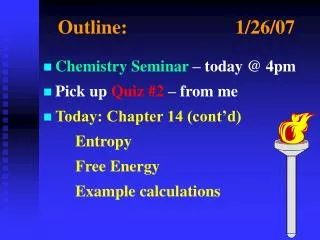
Outline: 1/26/07 • Chemistry Seminar – today @ 4pm • Pick up Quiz #2 – from me • Today: Chapter 14 (cont’d) Entropy Free Energy Example calculations
Quiz #2 Average: 6.1 (20.5% got 9 or 10….)
On what does entropy depend? • obvious • Temperature • Phase (s) () (g) • Molar mass • Concentration • less obvious • Generally, as molar mass , intermolecular disorder • Table 14-2: H2 = 130.7 J/K mol (page 580) F2 = 202.8 J/K mol • Cl2 = 223.1 J/K mol
On what does entropy depend? • obvious • Temperature • Phase (s) () (g) • Molar mass • Concentration • less obvious p.126
Given thermodynamic tables, DSrxn can be calculated: • CH4(g) + 2 O2(g) CO2(g) + 2 H2O(g) • 186.3 2(205.1) 213.7 2(188.8) • J/K mol J/ K mol J/K mol J/K mol • DSrxn = S Soproducts - S Soreactants • = -5.2 J/K • But isn’t it spontaneous ? • Need to check with the universe…
How useful is entropy? • If you can calculate the DS of the universe you can tell if a reaction is spontaneous... • DSuniverse not always easy to calculate...
The last thermo variable: DG • Gibb’s Free Energy: • DGsys = DHsys- TDSsys • If DG < 0 the system spontaneously reacts…. • For DG you only need to consider the system • (not the system + surroundings !)
Prove it! • Since DHsys = qsys (at constant P) • = - qsurr • Then DHsys = - T DSsurr • Plug into: DGsys = DHsys- TDSsys • DGsys = - T DSsurr- TDSsys • DGsys = - T (DSsurr+ DSsys ) • or DGsys = - T (DSuniverse )
Given thermodynamic tables, DGrxn can be calculated: • CH4(g) + 2 O2(g)=> CO2(g) + 2 H2O(g) • -50.7 0 -394.4 2(-228.6) • kJ/mol kJ/mol kJ/mol kJ/mol • DGrxn = SDGoproducts - SDGoreactants • = -801 kJ/mol • very spontaneous at 298 K !
Pb2+(aq) + SO42-(aq) PbSO4(s) • Ca2+(aq) + SO42-(aq) CaSO4(s) Reality check: • Predict which is spontaneous…. • Qualitative Chemistry rules revisited!
-24.4 -774.5 -813.4 • kJ/mol kJ/mol kJ/mol DGrxn = -14.5 kJ/mol spontaneous! • -553.6 -774.5 -1321.8 • kJ/mol kJ/mol kJ/mol DGrxn = 6.3 kJ/mol non-spontaneous! Which is spontaneous? • Pb2+(aq) + SO42-(aq) PbSO4(s) • Ca2+(aq) + SO42-(aq) CaSO4(s)
Better yet, DGrxn at different temperatures can be calculated: • DHorxn and DSorxn are relatively independent of temperature • DGTrxn DHorxn- TDSorxn
DGTrxn DHorxn- TDSorxn p.126
The beauty of DGTrxnis that you can now determine whether a reaction is spontaneous at any reasonable temp! Example:4 CuO(s) 2Cu2O(s) + O2 (g)At what temperature will this reaction become spontaneous? • Or conversely, at what temperature a reaction will become spontaneous!
Example: • 4 CuO(s) 2Cu2O(s) + O2(g) • DGTrxn 0 when first spontaneous…. Solve: 0 = DHorxn- TDSorxn • For this reaction: • DHorxn= + 227 kJ • DSorxn = + 221 J/K • (from appendix D) • Or: + 227 kJ= + T (0.221 kJ/K) • T =1027 K
Summary to date: • DE, DH, DS and DG are defined • First law calculations: DE = q + w • DHrxn, DHphasechange problems • DS calculations: T DS = q • DGorxn= DHorxn- TDSorxn problems • Since DHorxn and DSorxn are relatively independent of temperature: • DGTrxn DHorxn- TDSorxn
Practice Problems: Chapter 14 • 14.11, 14.15, 14.17, 14.19, 14.23, 14.25, 14.27, 14.31, 14.35, 14.37, 14.38, 14.41, 14.43, 14.49, 14.51, 14.53, 14.55, 14.57, 14.61, 14.65, 14.67, 14.71, 14.75, 14.77, 14.79, 14.81, 14.91, 14.101, 14.103