
Viruses
E N D
Presentation Transcript
Viruses Biology 4(C)
Viruses Learning objectives • Know the structure of viruses • Compare viruses to cells • Understand viral reproduction • Understand the role of viruses in diseases
Do viruses fulfill the characteristics of life? • Viruses cannot reproduce on their own • Need host machinery (ribosomes) • Viruses cannot metabolize energy • Need host energy • No, not considered biotic (a living thing) • What is a Virus?
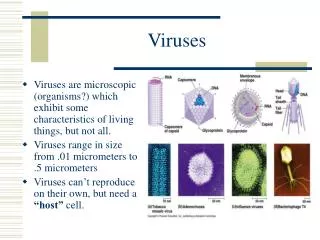
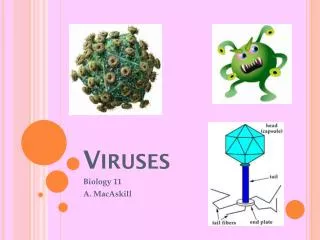
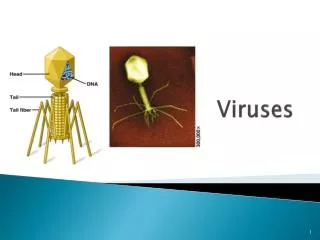
Capsid – protein shell that protects genetic information of virus • Viral Structure - Bacteriophage
Genetic information – strands of DNA or RNA used to make viral proteins inside infected hosts • Viral Structure - Bacteriophage
Tail – protein shaft that contracts to inject viral genetic information into host • Viral Structure - Bacteriophage
Tail fibers – proteins that attach to the outside of a host • Viral Structure - Bacteriophage
Membranous envelope – lipids that attach and fuse to hosts • Viral Structure – Other Types
Viruses • DNA or RNA • Need a host to replicate • Never contain organelles • Do not convert energy Cellular Life • Only DNA • Can reproduce independently • Eukaryotes contain organelles • Convert energy to perform tasks • Viruses vs. Cellular Life
Viruses need a host to reproduce • Goal: create more copies of their genetic material • Two methods • Lytic Cycle • Lysogenic Cycle • Viral Reproduction
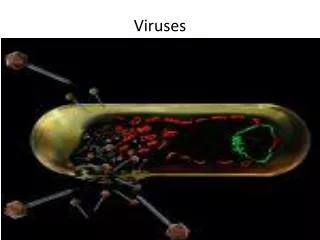
Lytic Cycle • Attaches to host • Injects genetic material into host • Cellular machinery duplicates genetic material and creates viral proteins (capsids, tail fibers) • New viruses are assembled • New viruses exit the cell by bursting the cellular membrane • End result – more viruses made, cell dies • Viral Reproduction – Lytic Cycle
Attachment Lytic Cycle • Viral Reproduction – Lytic Cycle Entry Release Replication Assembly
Lysogenic Cycle • Attaches to host • Injects genetic material into host • Viral genetic material is inserted into host genome • Viral genetic material lies dormant • When cell reproduces, new copies have viral genetic information • End result – more viral genome made, cell lives • Viral Reproduction – Lysogenic Cycle
Lysogenic Cycle • Viral Reproduction – Lysogenic Cycle Attachment Entry Separation Insertion Reproduction
Viral Reproduction Lytic Cycle • New viruses made • Cellular host dies Lysogenic Cycle • Genome copies made • Cellular host lives Viruses can use both cycles Infect many cells with lysogenic Create many viruses at once with lytic
Lytic & Lysogenic Cycles • Viral Reproduction
Some animal viruses exit without lysing the host • Envelopes that fuse to the host cell’s plasma membrane • Viral Reproduction in Animals Images by Matt Gonda [Public domain]
AIDS – acquired immune deficiency syndrome • Describes loss of immune system because of HIV • Caused by HIV - human immunodeficiency virus • makes helper T cells useless • Prevention • No vaccine • Limit transmission (use condoms) • Avoid transmission (use clean needles) • Viral Diseases - AIDS
Viral Diseases - AIDS Graoh by Jurema Oliveira [GFDL]
Initial infection • Helper T cells rapidly decline • Viral genome rapidly increases • Clinical latency • Viral genomes lay mostly dormant in infected cells • AIDS • Rate of viral creation outweighs helper T cell creation • Death • Immune system too weak to fight common pathogens • Viral Diseases - AIDS
Influenza (the flu) • Causes fever, fatigue, and respiratory infections • More severe than common cold, can be deadly • Viral Diseases - Influenza • Caused by a variety of influenza viruses • Change often, new vaccines yearly • Can blend with bird and swine strains to produce new viruses • Prevention • Seasonal vaccine • Limit transmission (wash hands) Image by NIAD [Public Domain]
The Common Cold • Causes fever, fatigue, and respiratory infections • Less severe than influenza • Caused by a variety rhinoviruses • Over 200 different virus strains • Prevention • No vaccine • Limit transmission (wash hands) • Viral Diseases – Common Cold Image by Robin S [GNU]
Hepatitis A • Causes inflammation of liver, jaundice appearance • Rarely results in liver failure • Caused by a hepatitis A virus • Carried through infected food or water • Prevention • Vaccine • Limit transmission (wash hands, food) • Viral Diseases – Hepatitis A Image by The CDC [Public Domain]