Download
1 / 12
120 likes | 223 Vues
This collection of images showcases various unsafe practices involving ladders and scaffolding at worksites, leading to potential hazards and accidents. The images highlight issues such as broken rails, missing rungs, improper ladder use, lack of fall protection, and inadequate personal protective equipment. Observing these visual examples serves as a stark reminder of the importance of following proper safety protocols when working at heights to prevent injuries and ensure workplace safety standards are met. Learn from these instances to avoid dangerous situations in your own work environment.

E N D
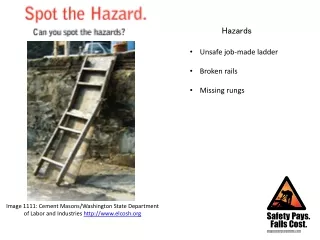
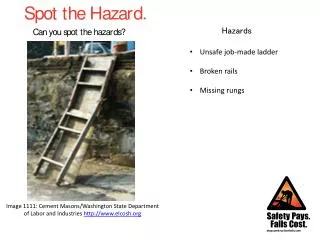
Unsafe job-made ladder • Broken rails • Missing rungs Image 1111: Cement Masons/Washington State Department of Labor and Industries http://www.elcosh.org
No fall protection / personal fall arrest system • No personal protective equipment (PPE) • Improper ladder use (less than 3 feet above the point of support, Not secured) Image 891: OSHA Training Institute, Southwest Education Center http://www.elcosh.org
No fall protection / personal fall arrest system • Improper use of an A-Frame step ladder Image 870: OSHA Training Institute, Southwest Education Center http://www.elcosh.org
Climbing the ladder with only one hand • Pry bar may get tangled in rungs Image 211: NIOSH/John Rekus http://www.elcosh.org
No fall protection / personal fall arrest system • No personal protective equipment (PPE) • Improper ladder use (less than 3 feet above the point of support, not secured) Image 889: OSHA Training Institute, Southwest Education Center http://www.elcosh.org
No fall protection / personal fall arrest system • No personal protective equipment (PPE) • No scaffolding or mechanical lift Image 868: OSHA Training Institute, Southwest Education Center http://www.elcosh.org
No fall protection / personal fall arrest system • No personal protective equipment (PPE) • Improper job-built ladder • Improper lifting practice • Falling material • Poor housekeeping • Possible improper ladder use Image 847: OSHA Training Institute, Southwest Education Center http://www.elcosh.org
No fall protection / personal fall arrest system • No personal protective equipment (PPE) • Tripping hazards • Improper slide guards Image 821: OSHA Training Institute, Southwest Education Center http://www.elcosh.org
Hazards • Scaffold overloaded (correct scaffold for the load, planking sags more than 1/60 of span) • Load is not on top of supports • Scaffold missing: cross bracing, full planking, falling object protection • No working space • Scaffold not level (leaning) Image 995: OSHA Training Institute, Southwest Education Center http://www.elcosh.org
Scaffold missing: cross bracing, full planking, falling object protection • Scaffold set up on top of unsecured excavation (no caution tape) • Scaffold footing not properly braced • Poor housekeeping • Improper ladder use (less than 3 feet above the point of support, not secured) • Ladder used is the top of an extention ladder, does not have feet Image 226: NIOSH/John Rekus http://www.elcosh.org
Ladders jack platform cannot be over 20 feet high • Improper ladder use (less than 3 feet above the point of support, not secured) Image 224: NIOSH/John Rekus http://www.elcosh.org
Improper scaffold guarding (midrail, toeboard or mesh) • No fall protection / personal fall arrest system • Improper use of scaffolding (working on an elevated work surface) • No access ladder shown Image 155: NIOSH/John Rekus http://www.elcosh.org