Combinatorial Counting Problems with Colored Balls: Sample Selection
Explore various counting problems involving selections from a container of colored balls. In the first scenario, we have 25 balls: 15 red and 10 white, and we aim to determine the different sample combinations from a selection of 5 balls. We will calculate the total samples possible, how many contain all red or all white balls, samples with a specific mix of colors, and those containing at least 4 red balls. In the second scenario, we analyze a container with 10 balls: 3 red, 3 blue, and 4 white, focusing on a sample of 3. Key questions investigate total samples, specific color combinations, and minimum color presence.

Combinatorial Counting Problems with Colored Balls: Sample Selection
E N D
Presentation Transcript
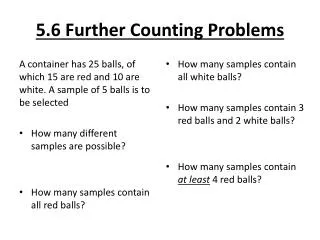
5.6 Further Counting Problems A container has 25 balls, of which 15 are red and 10 are white. A sample of 5 balls is to be selected • How many different samples are possible? • How many samples contain all red balls? • How many samples contain all white balls? • How many samples contain 3 red balls and 2 white balls? • How many samples contain at least 4 red balls?
5.6 Further Counting Problems A container has 10 balls, of which 3 are red, 3 are blue and 4 are white. A sample of 3 balls is to be selected • How many different samples are possible? • How many samples contain all red balls? • How many samples contain all white balls? • How many samples contain 2 white balls and 1 blue ball? • How many samples contain at least 2 white balls?
5.6 Further Counting Problems • Problems to complete from section 5.6 • Pg. 242 #4, 5