Finding Limits Numerically: A Guide to Understanding and Calculation Techniques
This guide explores three ways to find limits of functions numerically, graphically, and analytically. We focus on the concept of limits using function behavior as x approaches a specific value, c, without reaching it. By constructing value tables, we can observe how f(x) gets arbitrarily close to a limit, L. The guide provides practical examples and homework exercises to reinforce understanding. Discover the significance of limits in calculus and enhance your problem-solving skills with numerical approaches.

Finding Limits Numerically: A Guide to Understanding and Calculation Techniques
E N D
Presentation Transcript
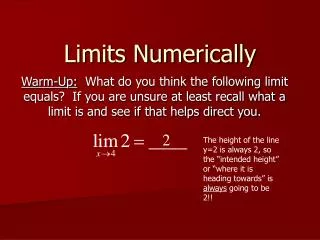
Limits • A function f(x) has a limit L as x approaches as c if we can get f(x) as close to c as possible but not equal to c. x is very close to, not necessarily at, a certain number c NOTATION:
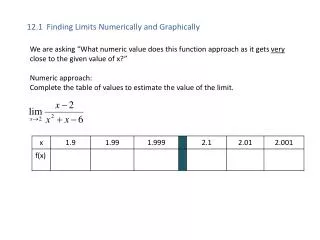
3 Ways to find Limits • Numerically - construct a table of values and move arbitrarily close to c • Graphically - exam the behavior of graph close to the c • Analytically
2 1) Given , find 3.61 3.9601 3.996001 3.99960001 4 2 4.004001 4.0401 4.41 4.00040001 4
1 2) Given , find 2.710 2.9701 2.997001 2.99970001 3 1 3.003001 3.0301 3.31 3.00030001 3
HOMEWORK Page 54 # 3-10 numerically