An Overview of GSM Technology for Cellular Communication Systems
110 likes | 252 Vues
Explore the fundamental features, services, and architecture of GSM, the globally popular standard for cellular communication. Learn about SIM cards, privacy encryption, service classifications, and system architecture.


An Overview of GSM Technology for Cellular Communication Systems
E N D
Presentation Transcript
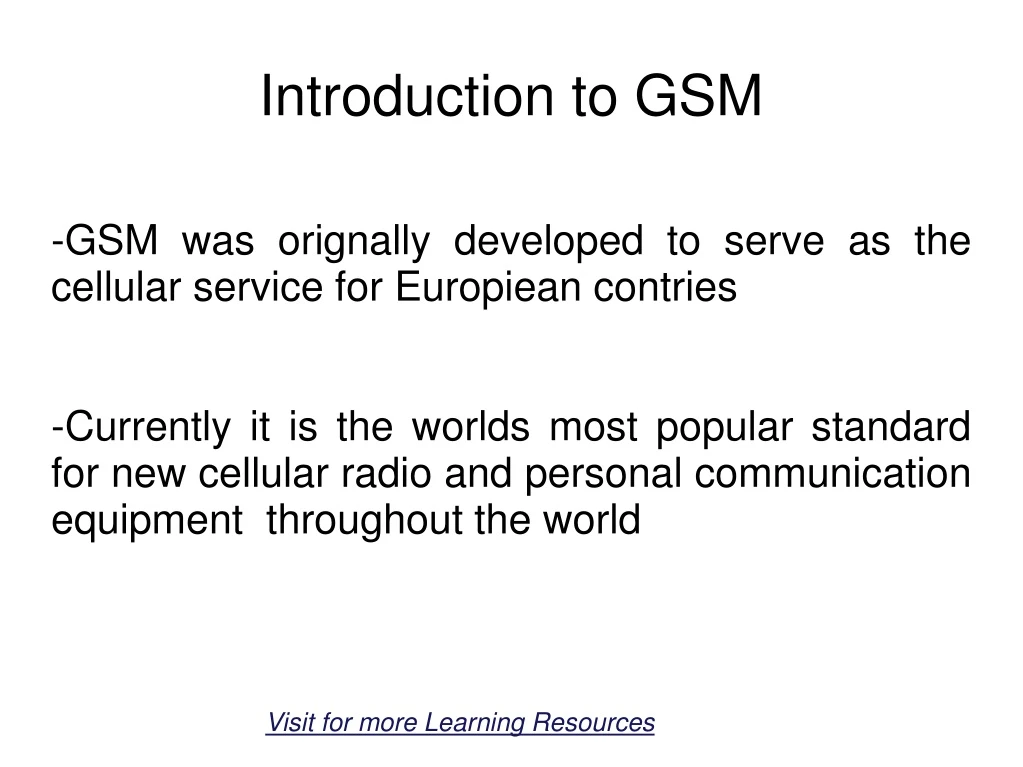
-GSM was orignally developed to serve as the cellular service for Europiean contries -Currently it is the worlds most popular standard for new cellular radio and personal communication equipment throughout the world Introduction to GSM Visit for more Learning Resources
GSM Features 1] SIM-Subscriber Identitity Module • Which stores information in the form of ID number,N/w and countries where subscriber is entitled to service,privacy keyes and other user specific information • Each subscriber have 4 digit personal ID no to activate GSM service 2]On The Air Privacy- • The privacy is made possible by encrypting the digital bit stream sent by GSM transmitter by using specific secret cryptographic key. • That is only known to cellular carrier • This key changes with time for each user • Every carrier and GSM eqipment manufacturermust sign the memorandum of understanding before developing GSM eqipment
Continue...... • The Mou is an international agreement which allows the sharing of cryptographic algorithm and other information between countries and carriers
GSM Services • GSM services follow ISDN Guidlines and are classified into 1]Teleservices 2]Data service 3]User service 1]Teleservice-Standard Mobile telephony 2]Data service-Computer -to-computer communication and packet switched traffic 3]User service-they are divided into three major categories 1]Telephone service 2]Bearer Service 3]Supplimentary ISDN services
Continue..... 1]Telephone services- • Including emergency calling,videotext and teletex 2]Bearer services- • Supports packet switched protocol and data rates from 300 bps to 9.6 kbps • The mode in which data can be transported could be transparent or non transparent mode
Continue 3]Supplimentary ISDN service - • Digital in nature • It includes call diversion,closed user groups and caller identification • They also include the short messege service which allow GSM subscriber and base stations to transmit alphanumeric pages of limited length • While simultaneously carring normal voice traffic • SMS also provides cell brodcasting which allows gsm BASE Station to repetitively transmit ASCII messages with as many as fifteen strings in concatenating fachion
Continue......... • GSM system architecture consist of three major interconnected subsystem that interact between themselves • BSS-Base station Subsystem • NSS-Network and switching subsystem • OSS-Operation Support subsystem For more detail contact us