Understanding Sheep Breeding: Key Traits, Genetic Improvement, and Effective Operations
210 likes | 338 Vues
This lecture delves into the essentials of sheep breeding, focusing on the importance of traits, genetic improvement, and the complexities of registration records. We explore the selection differential, heritability, and generation intervals vital for optimizing breed performance. Key economic traits for ewes and rams are identified, as well as the significance of NSIP for fair comparisons and estimates. The lecture also discusses contemporary groups, breeding schemes, and why the sheep industry often hesitates to embrace genetic advancements for commercial success.


Understanding Sheep Breeding: Key Traits, Genetic Improvement, and Effective Operations
E N D
Presentation Transcript
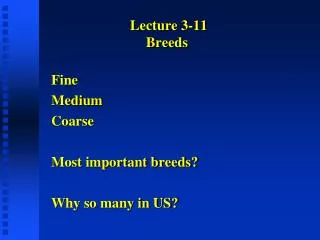
Fine Medium Coarse Most important breeds? Why so many in US? Lecture 3-11 Breeds
Purebred Operations: More records required Registration work Traits important to breed Performance Records
1. Selection differential 2. Heritability 3. Generation interval Genetic Improvement: 3 factors
SD is the superiority of replacements compared to flock average. Example: Average adjusted WW 60 Replacement Ewes - 70 70 - 60 = 10 x .5 x .2 SD = 1.0 Selection Differential
Replacement Ram = 85 pound adj. ww 85 - 60 = 25 x .5 x .2 SD = 2.5 Total SD = 2.5 + 1.0 = 3.5
Sires provide more improvement SD with only one trait More traits - SD per trait decreases Limits to Selection Differential
% of what you see which is due to genetics. Traitsh2 Reproduction .1 - .2 Growth .25 - .40 Carcass .3 - .5 Wool .4 - .6 Heritability
Low h2 traits require multiple records Example: Lambs born h2 - .10 with r < .20 Repeatability - likelihood that a ewe twinning in 2013 will twin in 2014. Lamb crop in U.S. has not increased. Number born increases with ewe age
Selection based on one record must account for fixed effects. Ex: 5 year old ewe with twins in 2013 Individual record not important. Perspective buyers What has she done relative to flock average each of past five years
Wool traits highly heritable highly repeatable one record of performance
Generation Interval How fast the flock turns over. GI = Average Ewe Age + Average Ram Age 2 4 + 2 = 3.0 2
GI - Smallest possible = 1 Economic suicide Why ?? Best Solution = let ewe age float Rams use only one year Use older rams from other flocks
Economic Traits Ewes: Pounds Weaned Mothering ability Milking ability Prolificacy Growth Hardiness and Longevity Extended Breeding Season Accelerated Lambing
Economic Traits Rams: Offspring Vigor and Livability Lambing Ease Rate of Gain Feed Efficiency Breeding Capacity Carcass Cutability
Genetic Improvement Set Selection Goals Identify Superior Individuals NSIP - uses all performance records - fair comparisons via contemporary groups - provides genetic estimates on animals without records ex. rams and young lambs
NSIP Traits Maternal Lambs born Lambs weaned Pounds Weaned Maternal Milk Growth birth, weaning, post wean Wool Grease Fleece Weight (GFW) Fleece Length Fleece Grade
NSIP Traits Carcass Backfat Eye Muscle Depth Parasite FEC Indexes Western Range Carcass Plus Ewe Productivity
Adjust for: Dam Age Type of Birth and Rearing Age Adjustment Sex Fixed Effects
Contemporary groups What is it? When are they needed?
Lamb Plan Wool Plan Ewe Byte Group Breeding Schemes Great Britain SUFFOLK SIRE REFERENCE SCHEME Canada Western Suffolk Sire Reference program Ontario Suffolk Sire Reference program US: Mount Rushmore Polypay Consortium Sire Max Why is group breeding successful. Other Sheep Improvement Plans
Why does sheep industry not embrace genetic improvement? Purebred breeders Commercial producers