Understanding the Knowledge Underpinning Technological Outcomes
90 likes | 212 Vues
This document explores the foundational knowledge necessary for developing technological outcomes, focusing on the professional technologists involved and the critical resources, materials, techniques, and procedures that guide effective practices. It covers how knowledge from various disciplines, including ethics and legislation, supports decision-making and innovation. By analyzing specific outcomes, students can identify gaps in information, assess the application of knowledge, and utilize reflective questioning to deepen their understanding of technological processes. This promotes critical thinking and application of learning to new contexts.


Understanding the Knowledge Underpinning Technological Outcomes
E N D
Presentation Transcript
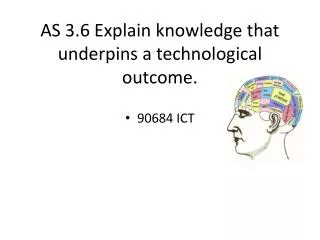
AS 3.6 Explain knowledge that underpins a technological outcome. • 90684 ICT
Steps • Select the professional technologist(s) and identify outcome they developed • Explain/discuss knowledge that underpinned the development of identified outcome - procedural and conceptual, link directly to standard entered for • Explain/discuss how knowledge and the way it was used supported the development of the outcome (for merit and excellence)
Knowledge that guides development could be from the use of…. • Key resources (people, time, software, materials, components) • Knowledge of materials (fitness for purpose, availability, costing, sustainability, transformation) • Key procedures (use of jigs and templates, functional modelling, tests in-situ) • Key techniques (measuring, testing, processing, evaluating, communication, evaluating, finishing) • Knowledge from other disciplines • Codes of practice • Codes of ethics, legislation
Activity • Choose a technological outcome to study. • On worksheet identify the knowledge that underpinned the development of the technological outcome • What information is missing, where could this be accessed from?
Sentence enablers • Technologist A would have understood that…this would have led him to … • In order to proceed technologist A had to know… • Through testing… the technologist had to make a decision….
Question for Analysing • Which events could not have happened? • If. ..happened, what might the ending have been? • How is...similar to...? • What do you see as other possible outcomes? • Why did...changes occur? • Can you explain what must have happened when...? • What are some or the problems of...? • Can you distinguish between...? • What were some of the motives behind..? • What was the turning point? • What was the problem with...? (Pohl, Learning to Think, Thinking to Learn, p. 13)