Re-Invigorating ISM and Developing Effectiveness Measures: Experiences from Pantex
210 likes | 418 Vues
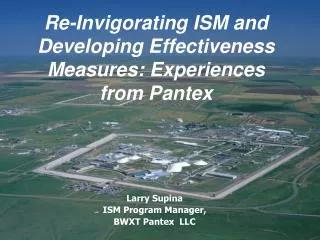
Re-Invigorating ISM and Developing Effectiveness Measures: Experiences from Pantex. Larry Supina ISM Program Manager, BWXT Pantex LLC. What is Pantex?. 16,000 Acre WWII Munitions Factory Nuclear Weapons Final Assembly High Explosives Formulation, Synthesis, Fabrication and Machining


Re-Invigorating ISM and Developing Effectiveness Measures: Experiences from Pantex
E N D
Presentation Transcript
Re-Invigorating ISM and Developing Effectiveness Measures: Experiences from Pantex Larry Supina ISM Program Manager, BWXT Pantex LLC
What is Pantex? • 16,000 Acre WWII Munitions Factory • Nuclear Weapons Final Assembly • High Explosives Formulation, Synthesis, Fabrication and Machining • 3300 Employees Most Importantly for Today’s Discussion, Pantex is……………… • Bldg. 12-1 as built in 1945
What is Pantex? (cont) • Hands-on Mechanical Activities • Very Linear, Not Interactive • Very Simple, Passive Systems • Complex, Intricate, Arcane Rules Pantex is, perhaps, the ultimate in low probability, high consequence event scenarios Dan Swaim General Manager, BWXT Pantex
“Good Operations” Six-Sigma Processes Improving Quality, Costs Increasingly Difficult and Complex Regulatory Basis Driving Operational Errors Pantex, circa 2002 Expectations for sustainable, error-free, superior plant performance not being met
BWXT Pantex ISM Performance Improvement Focus • Shift from “Manufacturing Bias” to “Nuclear Operations Culture” • Adopt “High Reliability Organization” • Establish a Superior Management Team at All Levels • Move from “Skills Training” to “Nuclear Operations Training”
Performance Objectives: Sustainable, Superior Plant Performance Sustainable, Event-Free Operations Avoidance of Unplanned, Long-Duration Shutdowns Well-Managed & Understood Safety, Design, and Operational Margins Superior Levels of Plant Worker Safety Highly Skilled, Knowledgeable and Collaborative Workforce Performance Objectives & Key Behaviors cited from INPO 05-003 and INPO Excellence in Human Performance Sept, 1997 12
Key Individual Behaviors: Communicate to create shared understanding Anticipate error-likely situations Confirm the integrity of defenses Improve personal capabilities Performance Objectives & Key Behaviors cited from INPO 05-003 and INPO Excellence in Human Performance Sept, 1997 12
Key Leader Behaviors: Facilitate open communication Promote teamwork to eliminate error-likely situations and strengthen defenses Search for and eliminate organizational weaknesses that create conditions for error Reinforce desired jobsite behaviors Value the prevention of errors Performance Objectives & Key Behaviors cited from INPO 05-003 and INPO Excellence in Human Performance Sept, 1997 12
Key Organizational Behaviors: Foster a culture that values prevention of errors Strengthen the integrity of defenses to prevent or mitigate the consequences of error Preclude the development of error-likely situations Instill a learning mindset and encourage continuous improvement Performance Objectives & Key Behaviors cited from INPO 05-003 and INPO Excellence in Human Performance Sept, 1997 12
Credits & References • Mr. Dan J. Swaim, General Manager BWXT Pantex • “Human Performance Improvement at Pantex” presented at the DOE HPI Confernce 2005 • Mr. John G. Meyer, Deputy General Manager BWXT Pantex • “Creating a Safety Culture” presented at the Pantex Executive Safety Council 2006 • Mr. Richard S. Hartley Phd. BWXT Pantex Nuclear Safety Oversight • “ISM Program Model” 2005 • Performance Objectives & Key Behaviors cited from INPO 05-003 and INPO Excellence in Human Performance Sept, 1997 • Managing the Risks of Organizational Accidents by James Reason • Support of benchmarking activities, LANL, LLNL, SNL Livermore, ORNL,
Management Development – A Three Year Drive! • Instilling Competency and Accountability • Cross-cutting All Levels • Building Mutual Commitment, Agreed Upon Methods of Business • Improved Selection (and Off-Ramp!) Processes No End in Sight
How Different Organizational Cultures Handle Safety Information Source: Managing the Risks of Organizational Accidents by James Reason
Continued Efforts in Progress Getting the Lesson “Learnable” Actually Learning the Lesson