Download
1 / 55
550 likes | 690 Vues
This document outlines key chemistry questions and explanations on atoms, isotopes, bonding types, and elemental properties for the academic year 2010-2011. It covers fundamental concepts behind the number of protons, neutrons, and electrons in isotopes, the reactivity of metals, and the principles of ionic and covalent bonding. Detailed answers and rationales enhance understanding of each question's topic, contributing to a solid foundation in chemistry.

E N D
Question #1 • Which of the following atoms contains 30 protons, 40 neutrons and 28 electrons? • A: 70 Zn+2 • B: 70 Zn-2 • C: 40 Zn+2 • D: 30 Zr-2
Answer to Q#1 • Letter A: 70 Zn+2 is the answer. • Why? The format for chemical symbols is A Xcharge z • Remember, A = mass, which equals protons + neutrons • Z = atomic number = protons • Charge = protons – electrons
Question #2 • The element boron has only two stable isotopes. One stable isotope has a mass number of 10 and the other has a mass number of 11. Which of the following could be the atomic weight of the element? • A: 9.5 • B: 10.8 • C: 11.7 • D: 12.4
Answer to Q#2 • Letter B: 10.8 is the answer • Why? The mass of an element on the periodic table is the weighted average of all the isotopes of that element
Question #3 • An atom of Argon—40 contains— • A: 18 protons and 18 neutrons • B: 18 protons and 22 neutrons • C: 18 protons and 40 neutrons • D: 20 protons and 20 neutrons
Answer to Q#3 • Letter B: 18 protons and 22 neutrons • Why? The 40 in Argon-40 is the mass of the isotope • Remember mass = protons + neutrons (electrons have no mass) • Argon has an atomic number of 18, so there 18 protons
Isotope/ Ion Quick Review • Isotopes of an element have the same atomic number (protons) but different masses (hence different neutrons) • Both protons and neutrons have a mass of 1 • Electron’s mass is not taken into account in the mass of an atom • Ions are anything with an electrical charge • Positively charged ions have lost electrons • Negatively charged ions have gained electrons
Question #4 • A scientist comparing K and Ca would find that K has a— • A: lower electronegativity and a smaller atomic radius • B: higher electronegativity and a smaller atomic radius • C: lower electronegativity and a larger radius • D: higher electronegativity and a larger atomic radius
Answer to Q#4 • Letter C: lower electronegativity and a larger atomic radius • Why? Electronegativity gets higher as you go across a period and atomic radius gets smaller as you go across a period • K is farther left so it must have a lower electronegativity and larger atomic radius
Question #5 • Which of the following elements is the most reactive? • A: Cs • B: Sr • C: Mg • D: Rb
Answer to Q#5 • Letter A: Cs • Why? All these elements are metals—the most reactive metals are the largest • Atomic radius gets larger as you go down a group • Cs is farthest down so it is the largest and most reactive
Trends Quick Review • Trends as you go down a group: larger atomic radius, lower electronegativity, lower and ionization energy (easier to lose an electron) • Trends as you go across a period: smaller atomic radius, higher electronegativity, and higher ionization energy (harder to lose an electron) • Remember IE is the energy it takes to lose an electron • Electronegativity is the ability to gain an electron
Quick Review Continued • Metal reactivity: Largest metals = most reactive metals. • Remember metals like to lose electrons • Non-metal reactivity: smallest non-metals = most reactive non-metals. • Remember non-metals like gain electrons • Noble gases are non-reactive—they have a full valence shell
Question #6 • A bond between an element of group 2 and an element of group 17 will be: • A: ionic • B: Nonpolar covalent • C: Polar covalent • D: Metallic
Answer to Q#6 • Letter A: Ionic • Why? Group 2 elements are metals (also known as alkaline earth metals) and group 17 (or 7) elements are non-metals (also known as halogens) • Metals + non-metals = ionic bonding
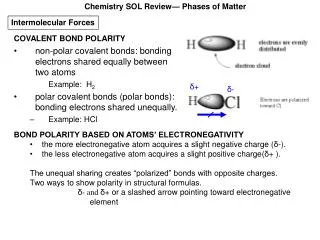
Bonding Quick Review • Covalent bonding = sharing of electrons between non-metals • Ionic bonding = transferring of electrons between metal + non-metal • Nonpolar covalent bond = equal sharing of electrons between non-metals • Polar covalent bond = unequal sharing of electrons between non-metals
Question #7 • What is the name for Cu2S? • A: Copper sulfide • B: Copper (I) sulfide • C: Dicopper sulfide • D: Dicopper monosulfide
Answer to Q#7 • Letter B: Copper (I) sulfide • Why? Copper is a transition (d block) metal, so you must use roman numerals to indicate its charge • Look behind S for the charge of Cu. • Charge is +1 so copper (I) sulfide
Question #8 • Which of the following is the formula for carbonic acid? • A: HC • B: HCO • C: HO • D: H2CO3
Answer to Q#8 • Letter D: H2CO3 • Why? It’s an acid so H must come first. Carbonic = carbonate = CO3-2 • H+1 + CO3-2 = H2CO3
Question #9 • What is the molecular formula of tetraphosphorus decoxide? • A: PO • B: P4O • C: P4O10 • D: PO10
Answer to Q#9 • Letter C: P4O10 • Why? Tetra = 4 and deca = 10 • So P4O10 • Remember, when using prefixes don’t switch—simply write what’s given
Naming Quick Review • Must use roman numerals to indicate charge of a transition metal • Only use prefixes when the compound is all non-metals • If an acid has hydro prefix then it’s H+element • If no hydro prefix for an acid then it’s H+polyatomic
Question #10 ___C3H4 + ___O2 ___CO2 + ___H2O • When the equation above is balanced, what is the sum of the coefficients? • A: 4 • B: 5 • C: 8 • D: 10
Answer to Q10 • Letter D: 10 • Why? C3H4 + 4O2 3CO2 + 2H2O; so 1+4+3+2 = 10 • Don’t forget the law of conservation of mass says the reactants side = products side
Question #11 • Which of the following is an example of a decomposition reaction? • A: 2AgCl 2Ag + Cl2 • B: CuO + H2O Cu(OH)2 • C: AgCl + Mg MgCl2 + Ag • D: HCl + Na(OH) H2O + NaCl
Answer to Q #11 • Letter A: 2AgCl 2Ag + Cl2 • Why? Decomposition is when you start with one reactant and break into 2 products • Letter B = synthesis; letter C = single replacement and letter D = neutralization reaction
Question #12 • 12 x 403 = • What is the answer to the above problem expressed with proper sig figs? • A: 5,000 • B: 4800 • C: 4830 • D: 4836
Answer to Q#12 • Letter B: 4800 • Why? When multiplying or dividing, you use lowest # of sig figs for your answer • 12 only has two sig figs, so your answer can only have two
Question #13 • How many atoms of Na are in 0.300 moles of Na? • A: 0.0131 atoms • B: 7.86x10²¹ atoms • C: 1.81x10²³ atoms • D: 6.02x10²³ atoms
Answer to Q#13 • Letter C: 1.81x10²³ atoms • Why? 0.300 moles Na x 6.02x10²³atom 1 mole = 1.81x10²³ atoms
Question #14 • How many moles are in a 342grams of CaO? • A: 6.10 moles • B: 56.1 moles • C: 1.92x10⁴ moles • D: 3.67x1024 moles
Answer to Q#14 • Letter A: 6.10 grams • Why? 342g x 1mole CaO = 6.10 moles 56.08 grams • 56.08 grams is the molar mass of CaO from the Periodic Table
Moles Quick Review • When multiplying/dividing use lowest # of sig figs for answer • When adding/ subtracting use lowest # of decimal places for answer • MassMoles use mass of Periodic Table = 1 mole • Moles Particles use 1 mole = 6.02x10²³ particles • Moles Liters at STP use 1 mole = 22.4 L
Question #15 Be + 2HCl BeCl2 + H2 • Using the above reaction, what mass of beryllium was consumed in the reaction if 4.0 moles of HCl were used? • A: 2.0grams • B: 9.0 grams • C: 18.0 grams • D: 36.0 grams
Answer to Q#15 • Letter C: 18.0 grams • Why? • 4.0molsHCl x 1mols Be x 9.01gBe 2 mols HCl 1 mole Be = 18.0 grams Be
Letter #16 2C2H6 + 7O2 4CO2 + 6H2O • In an experiment, 0.500 mols of C2H6 were reacted with 1.50 moles of oxygen gas. Which of the following is the limiting reactant in this experiment? • A: C2H6 • B: O2 • C: CO2 • D: H2O
Answer to Q #16 • Letter B: O2 • Why? 0.500molsC2H6 x 4mols CO2 2 mols C2H6 = 1.00 mols CO2 • 1.50molsO2x4mols CO2 = 0.857molsCO2 7 mols O2 • Since O2 produces less CO2, it must be the limiting reactant • C and D shouldn’t even be choices b/c they are products!
Stoich Quick Review • Mass A Mols A Mols B Mass B • Go from mols A mols B using mol to mol ratio from coefficients of balanced equation • Limiting reactant is the one used up first. It also produces the smaller amount of product • % yield = (actual/theoretical) x100 • Can also use stoich to go from mass/mols of A to liters of B; use 22.4 L = 1mol at STP
Question #17 • Which of the following is NOT a part of the kinetic molecular theory? • A: Gases move in a straight, continual motion • B: Gases have no volume themselves • C: Gases participate in inelastic collisions • D: Kinetic energy is directly related to temperature • E: Gases feel no attractive forces
Answer to Q#17 • Letter C: Gases participate in inelastic collisions • Why? Gases actually participate in elastic collisions. • The other 4 parts are all TRUE
Gas Laws Quiz Review • Boyle’s Law P1V1 = P2V2, where P and V are inversely related. • Charles’ Law V1/T1 = V2/T2 • Gay-Lusac P1/T1 = P2/T2 • Combined Gas Law (P1V1)/T1 = (P2V2)/T2 • Ideal Gas Law PV = nRT, where R = 0.0821 (L*atm)/(mol*K)
More Gas Laws Review • Must always convert temperature from celsius to KELVIN! • Absolute zero is -273C or 0K! • Absolute zero is the point where all motion slows down and stops • Dalton’s Law P1+P2+P3… = Ptotal
Question #18 • Which of the following phase changes occurs at the arrow? • A: Sublimation • B: Melting • C: Evaporation • D: Condensation
Answer to Q#18 • Letter B: melting • Why? Graph always goes S, L, G—look at pic on right • The arrow points to line b/w solid and liquid • Only phase changes there are melting (SL) or freezing (LS)
Phases Quick Review • 6 phases changes • Melting (SL) --Freezing (LS) • Evaporation (LG) --Condensation (GL) • Sublimation (SG) --Deposition (GS) • Molar heat of fusion = amount of energy needed to melt 1 mole of a substance • Molar heat of vaporization = amount of energy needed to evaporate 1 mole of a substance • Specific heat capacity = amount of energy needed to raise the temperature of 1 gram of a substance by 1˚C use q = mxCpxΔT
IMF Quick Review • Four different intermolecular forces • London dispersion (weakest) = nonpolar covalent molecules • Dipole-dipole = polar molecules • Hydrogen bonding = H connected to N, O or F bonding to another O, N or F • Ionic (strongest) = metal + non-metal • Don’t forget to do the arrow test to determine polarity of a molecule
Question #19 • How many moles of MgCl2 are present in 3.00 liters of a 0.150M MgCl2 solution? • A: 0.0500 moles • B: 0.450 moles • C: 1.35 moles • D: 20.0 moles
Answer to Q#19 • Letter B: 0.450 moles • Why? Molarity (M) = mols/liters • So 0.150 M = x/3.00 L • (0.150M)(3.00L) = x • X = 0.450 moles