Download
1 / 24
240 likes | 374 Vues
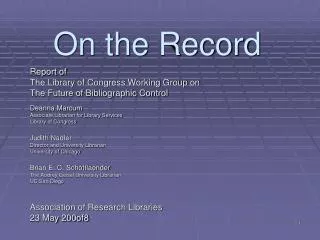
This report outlines the findings and recommendations from the Library of Congress Working Group on the Future of Bibliographic Control. Charged with enhancing management and access to library materials in a changing information environment, the group conducted public hearings and engaged with stakeholders. Their vision emphasizes collaborative, decentralized bibliographic practices and strategic recommendations to increase efficiency, enhance access to hidden materials, and position technology for future support. This document serves as a call to action for the library community.

E N D
On the Record Report of the Library of Congress Working Group on the Future ofBibliographic Control Diane Boehr Head of Cataloging, NLM boehrd@mail.nlm.nih.gov For MLA Annual Meeting May 20, 2008
Background • The Working Group was charged to: • Present findings on how bibliographic control and other descriptive practices can effectively support management of and access to library materials in the evolving information and technology environment; • Recommend ways in which the library community can collectively move toward achieving this vision; • Advise the Library of Congress on its role and priorities.
The Process • Three public hearings, March–July 2007: • Users and uses of bibliographic data (held at Google headquarters, San Jose) • Structures and standards for bibliographic control (held at ALA headquarters, Chicago) • Economics and organization of bibliographic control (held at LC, Washington, DC) • Draft report issued Nov. 30, 2007 • Two weeks for public comments • Final report issued Jan. 9, 2008
The Audience for the Report • LC • Current and potential participants in the bibliographic sphere • Policy makers and decision makers who influence the scope of operations and constraints upon participating organizations.
The Working Group’s Vision of the Future • The future of bibliographic control will be collaborative, decentralized, international in scope, and Web-based
Working Group’s Guiding Principles • Redefine bibliographic control • Redefine the bibliographic universe • Redefine the role of the Library of Congress
High level recommendations • Increase the Efficiency of Bibliographic Record Production and Maintenance • Enhance Access to Rare, Unique, and Other Special Hidden Materials • Position our Technology for the Future • Position our Community for the Future • Strengthen the Library and Information Science Profession
1. Increase efficiencies • Eliminate Redundancies • Make use of bibliographic data available earlier in the supply chain • Re-purpose existing metadata for greater efficiency • Fully automate the CIP process
1. Increase efficiencies (con’t.) • Distribute responsibility • Share responsibility for creating and maintaining bibliographic records • Collaborate on authority record creation and maintenance • Increase re-use of assigned authoritative headings among various communities • Internationalize authority files
1. Increase efficiencies (con’t.) • Economics • Re-examine current economic model for data sharing in the networked environment • Increase incentives for sharing bibliographic records
2. Enhance Access to Hidden Collections • Make the discovery of rare & unique materials a high priority • Provide some level of access to all material, rather than comprehensive access to some material and no access at all to other material • Encourage digitization to allow broad access • Share access to unique materials
3. Position Technology for the Future • Web as Infrastructure • Develop a more flexible, extensible metadata carrier • Express library standards as well as library data in machine- readable and machine-actionable formats • Extend use of standard identifiers
3. Position Technology for the Future (con’t) • Standards Development • Improve the standards development process • Develop standards with a focus on return of investment • Incorporate testing and implementation plans as integral parts of the development process
3. Position Technology for the Future (con’t.) • Suspend further new work on RDA • The promised benefits of RDA are not discernable in the drafts seen to date • Business case for moving to RDA has not been made satisfactorily, particularly given the potential costs of adoption • More real-world testing of the FRBR model, on which RDA is based, is needed
4. Position our Community for the Future • Design for the future • Integrate user-contributed data, while maintaining the integrity of the library-created data • Provide links to appropriate external data • More research into use of computationally derived data • Clarify and further explore the use of the FRBR model in the Web environment
4. Position our Community for the Future (con’t.) • LCSH • Evolve & transform LCSH • Pursue de-coupling of subject strings • Encourage application of & cross-referencing with other controlled subject vocabularies • Recognize the potential of computational indexing in the practice of subject analysis
5. Strengthen the Profession • Build an evidence base • Encourage ongoing qualitative and quantitative research in bibliographic control • Design LIS education to meet present and future needs
In Summary • Report presents a vision and broad directions for the future • It is not a specific implementation plan • A call to action
LC’s Response • Three separate groups in the library reviewed the document • LC has committed to responding in writing to each of the separate recommendations by ALA Annual, June 2008
Impact on NLM? • Cataloging descriptive process could be streamlined • Catalogers could focus on the intellectual tasks of subject assignment, classification, and linkages between items • More of NLM’s cataloging resources could be devoted to providing access to our hidden collections
Other things NLM could do • Work with Lister Hill to develop automated means of disambiguating authors • Work with publishers to assist in developing author identifiers • Use authorized name headings in indexing citations as well as in bibliographic records
Other things NLM could do • Work cooperatively with LC to develop crosswalks between MeSH and LCSH • Investigate the possibility of user tagging for bibliographic citations. Review the tags to enhance the MeSH vocabulary and/or PubMed mappings
Access the Working Group’s Report • http://www.loc.gov/bibliographic-future/