Understanding Permutations: Order Matters in Selections and Arrangements
A permutation is an arrangement of objects where the order of selection is essential. For instance, visiting three houses—Andrew’s (A), Betty’s (B), and Carlos’ (C)—can be arranged in different orders, leading to six total permutations (A, B, C; A, C, B; B, A, C; B, C, A; C, A, B; C, B, A). Importantly, permutations do not allow repeats and consider order. Learn how to differentiate between permutation and non-permutation problems and calculate total permutations effectively, such as arranging finishers in a race.

Understanding Permutations: Order Matters in Selections and Arrangements
E N D
Presentation Transcript
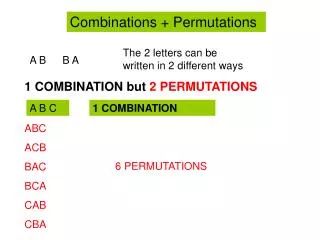
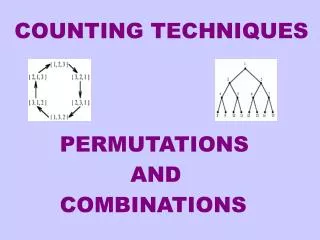
Definition of Permutation An arrangement of objects in which the order of selection matters. Ex: You have to visit Andrew’s house (A), Betty’s house (B), and Carlos’ house (C) but you have not decided the order. What are the different ways you can visit all 3 houses? The keys to Permutations are: no repeats AND order does matter. A,B,C B,A,C C,A,B A,C,B B,C,A C,B,A Each arrangement is one permutation of the elements A, B, and C. In other words, there are 6 total permutations.
Permutation v Non-Permutation Which problem(s) below represents a permutation problem? Explain why and why not. Craig needs to select an ATM pin. He can choose any 4 digit number using the integers 0 to 9. The Lifetime TV Network has a total of 147 annual viewers. They are offering a promotion for the first three callers. The first caller wins $25, the second $15, and the third $1. Joanne has 20 friends and needs to select 3 of them to go on vacation with her. Repeats Allowed Order Matters and no Repeats Order does not Matter
How to Calculate the Total Number of Permutations The total number of ways (without repeats) to choose AND arrange r objects from a set of n objects (order matters). Ex: If there are 10 people in a race, how many different ways can the top 3 finishers be arranged?