
Enhancing Productivity and Employee Engagement in Modern Management
E N D
Presentation Transcript
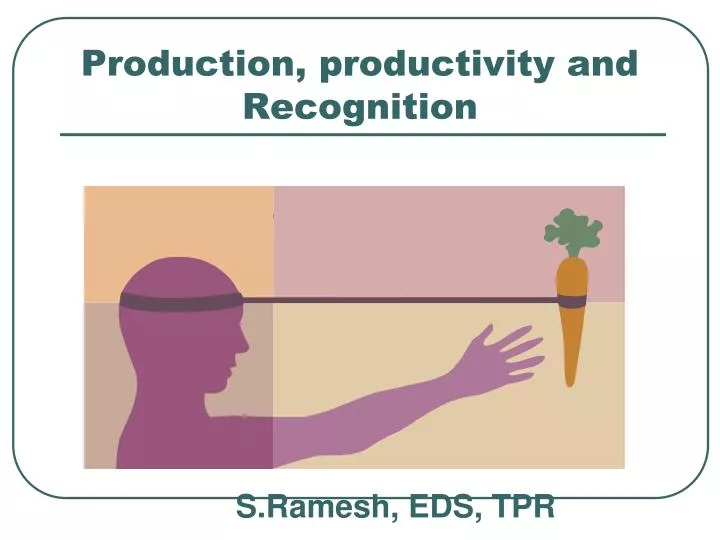
Production, productivity and Recognition S.Ramesh, EDS, TPR
Requirements For Today’s Managers • In alignment (to be on the team) • Thinking out the box (be creative) • Empowering employees • Maintaining core competencies • Managing change
Requirements For Today’s Employees (1 of 2) • Flexibility - accept change readily • Clock speed - move faster, think faster • Accept ambiguity & uncertainty • Stay current - commit to life-long learning • Contribute - add more value than you take
Requirements For Today’s Employees (2 of 2) • Manage yourself - fixer not finger pointer • Don’t get a job, make a job
Job Design Techniques for Improving Productivity • Job simplification • Job rotation • Job enlargement • Job enrichment • Job sharing
Teams and Productivity • Content (goals and outcomes) and process (how the team accomplishes tasks) - productive teams pay attention to both. • Cohesion - Team must be cohesive but must not want agreement more than accuracy (or quality of outcome).
Undercurrents in Team Dynamics (Continued) • Relationships between team members • Effects on rank and positions • Friendship and formality • Openness • Personality preferences
Employee Involvement • Employee involvement means allowing employees to participate in work-related decisions and improvement activities that affect them. • This doesn’t mean anarchy, but it means that management shares its responsibilities in decision-making with employees.
Benefits of Employee Involvement • Increases trust and commitment. • Improves employee communications and attitudes. • Involved employees are more likely to generate new ideas and achieve a higher quality of work life • Reduce the workload of managers
Information sharing Dialogue Individual problem solving Intra-groupproblem solving Inter-group problem solving Focused problem solving Limited self-direction Total self-direction Levels of Employee Involvement
Approaches to Involving Employees • Commitment from management • Must be long-term, ongoing attempts • Communications efforts • feedback • “bottom-up” communications • employee surveys and suggestion systems • Training and education
Conclusions • Productivity improvement (PI) is critical to every organization for survival • Every employee should have basic knowledge and skills to contribute to PI • Organizations need to have clear PI strategies • Successful PI does not ensure long-term profitability nor competitiveness