Download
1 / 31
320 likes | 441 Vues
As businesses expand into international markets, a thorough understanding of regional uniqueness is crucial. This analysis emphasizes the need for sufficient, accurate, and timely information regarding market characteristics, buyer behavior, and local institutions. By assessing growth rates, market saturation levels, and socio-cultural factors, firms can adapt their strategies or standardize approaches effectively. Identifying commonalities with existing markets and utilizing diverse data sources can enhance marketing effectiveness and operational planning across distinct regions.

E N D
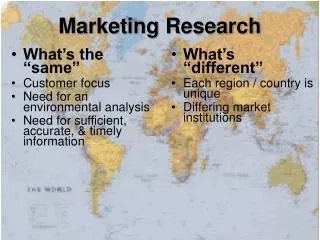
What’s the “same” Customer focus Need for an environmental analysis Need for sufficient, accurate, & timely information What’s “different” Each region / country is unique Differing market institutions Marketing Research
Overarching Issues • What are the unique characteristics of the intended market? • What characteristics are in common with a currently penetrated market? • Can multiple markets be clustered together for operating and or planning purposes? • What dimensions should be used to cluster markets? • Adapt to market or standardize?
Information Categories • Market characteristics • Size of market: rate of growth • Stage of development • Stage of product life cycle; saturation levels • Buyer behavior characteristics • Social / cultural factors • Physical environment
Information Categories • Marketing institutions • Distribution systems • Communication media • Marketing services (advertising & research)
Information Categories • Marketing institutions • Distribution systems • Communication media • Marketing services (adv. & research) • Industry conditions • Competition size & practices • Technical development
Information Categories • Legal environment • Laws, regulations, codes, tariffs, taxes
Information Categories • Legal environment • Laws, regulations, codes, tariffs, taxes • Resources • Personal (availability, skill, potential & cost) • Money (availability & cost)
Information Categories • Political environment • Current government policies and attitudes • Long-range political environment
Market Research • Primary or secondary data? • Cost effective? • Relevant? • Accurate? • Timely?
Obstacles to collecting International Secondary Data • Comparability • Comparing data from one country / region to another (differences & errors) • Lack of current data • Frequency of surveys & data collection varies • Cost • Especially when privatized
Obstacles to collecting International Primary Data • Language • Translation / back-translation • Requires re-testing survey tool
Obstacles to collecting International Primary Data • Language • Translation / back-translation • Requires re-testing survey tool • Infrastructure • May dictate different techniques (e.g. poor phone system or poor postal syst.)
Obstacles to collecting International Primary Data • Language • Translation / back-translation • Requires re-testing survey tool • Infrastructure • May dictate different techniques (e.g. poor phone system or poor postal syst.) • Cultural • Differing attitudes towards research; from avoidance to fabrication
Resolving data challenges • Segment the research task • Utilize resources • USDOC offers primary data collection service • Conducted by commerce dept. employees based in U.S. foreign offices • All local, state, and federal resources • ITA, World Trade Centers, Industry associations
Dealing with data problems • Complementary product or industry substitution • “Bad” indicator / classification code • National statistics substitution • Correlate demographic and consumption statistics • Ratio comparisons • Use data for known areas to predict • Timeline comparison • Level of consumption to development
Data needs & sources • Economic & demographic data • STAT-USA <http://domino.stat-usa.gov/>Most Local and State trade assistance centers and Federal Depository Libraries offer free access • National Trade Data Bank (NTDB) • Global Business Opportunities GLOBUS • State of the Nation
Data needs & sources • Economic & demographic data • Country Commercial Guides (CCG) • Available for most countries • Updated annually • CIA World Factbook • Greater detail than the CCGs • Geography, resources, population demographics, government, infrastructure, military and economic indicators • Department of State Background Notes
Data needs & sources • Economic & demographic data • US Foreign Commercial Service • Country Market Profiles (CMP) • Single country, multi-industry reports • Country Trade Statistics (CTS) • Single country over a 5 year period • Foreign Economic Trends (FET) • Current business & economic developments • International Market Information (IMI • Unique market situations
Data needs & sources • Economic & demographic data • U.S. Agency for International Development (USAID) • Congressional Presentations • Trade & Development Program, Dept. of State • Congressional Presentation • DUN’s Marketing Service • Exporter’s Encyclopedia (800) 526-0651
Data needs & sources • Economic & demographic data • Center for International Research • World Population (demographic data) • ITA - USDOC • International Economic Indicators • International Monetary Fund (IMF) • International Financial Statistics • World Bank • World Bank Atlas • World Development Report
Data needs & sources • Fax retrieval systems / web sites • USDOC Trade Information Center • (800) USA-Trade (872-8723) • www.ita.doc.gov • USDOC Country desk officer • Each assigned to one or more countries or markets • Get listing from TIC or Export Asst. Cntr. • Private resources • Ernst & Young
Industry / Product specific Data • STAT-USA • Industry Sector Analysis (ISA) • Include local competitors, export / import statistics • International Market Insights (IMI) • More current (limited time duration) • Best Market Reports (BMR) • Groups markets by product classifications • US Exports of Merchandise • Uses harmonized code
Industry / Product specific Data • U.S. and Foreign Commercial Service • (202) 377-2432 • Export Statistics Profiles (ESP) • Available for 35 industries, $70 ea. • Custom Statistical Service • For products not in ESP ($50 - $1000) • International Market Research • Single industry, one country ($50 - $200) • Country Market Surveys (CMS) ($10) • 8 - 12 page summaries of IMR by indust.
Industry / Product specific Data • U.S. and Foreign Commercial Service • (202) 377-2432 • Annual Worldwide Industry Reviews • 9-20 countries per volume ($200 / volume) • Product Market Profiles (PMP) • Single product, multicountry ($300 - $500) • USDOC Competitive Assessments • Over 20 industries (202) 377-4944
Industry / Product specific Data • U.S. Govt. Printing Office • Foreign Trade Report (FT410) $100/yr • U.S. Comercial Officers • Comparison shopping service • Specific product, single country • National Technical Info. Service • Market Share Reports ($6.50 ea)
Industry / Product specific Data • U.S. Small Business Administration • Export Information System Data Reports (XIS) • Information Clearinghouse • FINDEX: Directory of Market Research Reports, Studies and Surveys • Over 10,000 listings ($245) • (212) 354-2424
Industry / Product specific Data • USDOC Industry desk officers • “Relationship” based • Trade associations • Especially in international standards issues • Publications, journals, periodicals • Foreign phone books • <www.europages.com> • Networking • Suppliers / non-competing companies
Competitive Position • Competitive intelligence issues • Where are they selling? • To whom are they selling • How are they selling • How much are they selling, at what price? • What is there international strategic plan?
Key Sources of Competitive Info. • Databases • U.S. Exports by Commodity • Monthly compilation (harmonized code) • Port Import Export Reporting Service (PIERS) (expensive) • More detailed than Commodity report • Directory of U.S. Exporters • Compilation of PIERS reports • United Nations International Trade Statistics Yearbook • Less detailed than Commodity (Intntl.)
Key Sources of Competitive Info. • Company information • Company literature (and web sites) • Company advertising • Industry associations (pooled data) • Public information • Industry press • Newspapers
Key Sources of Competitive Info. • Interviews - direct contact • Press and advertising • Government • Foreign customers / distributors • Employees from competitors • Service / fraternal organizations