Understanding DNA: The Genetic Blueprint of Life
DNA, or deoxyribonucleic acid, is the hereditary code found in every cell of your body. Its structure resembles a twisted ladder, with sugar-phosphate backbones and nitrogenous base rungs (adenine, thymine, cytosine, guanine). It contains genes that store instructions for making proteins, which occur in the cytoplasm, facilitated by RNA. While DNA can mutate due to various factors like UV light or chemicals, these mutations can have beneficial or harmful effects. Understanding DNA is crucial for genetics, evolution, and medicine.

Understanding DNA: The Genetic Blueprint of Life
E N D
Presentation Transcript
What is DNA? • A code in the cell that contains the hereditary material • The code is a chemical called deoxyribonucleic acid • Every cell in your body contains DNA
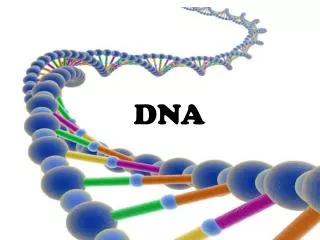
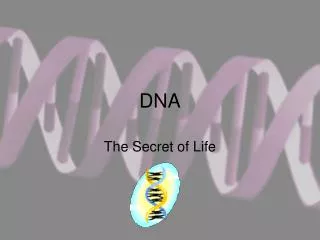
DNA Structure • Rosalind Franklin discovered that DNA is two chains of molecules in a spiral form by using an X-ray • Similar to twisted ladder • James Watson & Francis Crick made a model of DNA molecule
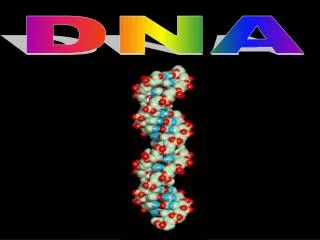
A DNA Model • Each side of the ladder is made of sugar-phosphate molecule • Called the “backbone” • Sugar = deoxyribose
Rungs of the ladder are made up of nitrogenous bases • There are four types of bases • Adenine (A) • Guanine (G) • Cytosine (C) • Thymine (T)
Base Pairing • Adenine always pairs with Thymine A-T • Cytosine always pairs with Guanine C-G
Copying DNA • The two sides of DNA unwind and separate • Each side becomes a pattern for a new DNA strand
Genes • DNA in your cells stores the instructions for making proteins • Each chromosome contains hundreds or thousands of genes
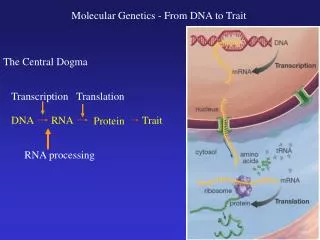
Making Proteins • Genes are found in the nucleus, but proteins are made on ribosomes in the cytoplasm • The code for making proteins are carried from the nucleus by RNA or Ribonucleic Acid
Ribonucleic Acid • RNA is different from DNA • RNA is not a spiral, but one single strand • RNA has the bases A, G, C, and U not T • U = Uracil • Sugar is ribose, not deoxyribose
Types of RNA • Messenger RNA (mRNA) • Transfer RNA (tRNA) • Ribosomal RNA (rRNA)
Controlling Genes • Each cell only uses some of the thousands of genes to make proteins • Cells must be able to control genes by turning some genes on and others off
Mutations • Permanent changes in the DNA sequence of a gene • These happen when the DNA is not copied correctly • They cause incorrect proteins to be made
Causes of Mutations • X-rays • Sunlight • Some chemicals
Results of Mutations • Some mutations are beneficial • They add variety to the species • Many mutations are harmful and can cause death • Cystic Fibrosis • Some mutations have no effect on the organism