Understanding Acids, Bases, and the pH Scale: Ionization and Concentration Calculations
80 likes | 212 Vues
This content covers the fundamental concepts of acids and bases, focusing on the ionization of water and the calculation of hydroxide ion concentration. It provides insights into the pH scale and how to determine the acidity or basicity of various solutions. Through examples, including the concentrations of HCl, HNO3, and HBr, it explains how to compute pH and pOH using logarithmic relationships. Featuring key formulas, this guide is essential for anyone studying chemistry or wanting to deepen their understanding of acid-base chemistry.


Understanding Acids, Bases, and the pH Scale: Ionization and Concentration Calculations
E N D
Presentation Transcript
Ch. 19 Acids & Bases II. pH
H2O + H2O H3O+ + OH- A. Ionization of Water Kw = [H3O+][OH-] = 1.0 10-14
A. Ionization of Water • Find the hydroxide ion concentration of 3.0 10-2 M HCl. [H3O+][OH-] = 1.0 10-14 [3.0 10-2][OH-] = 1.0 10-14 [OH-] = 3.3 10-13 M Acidic or basic? Acidic
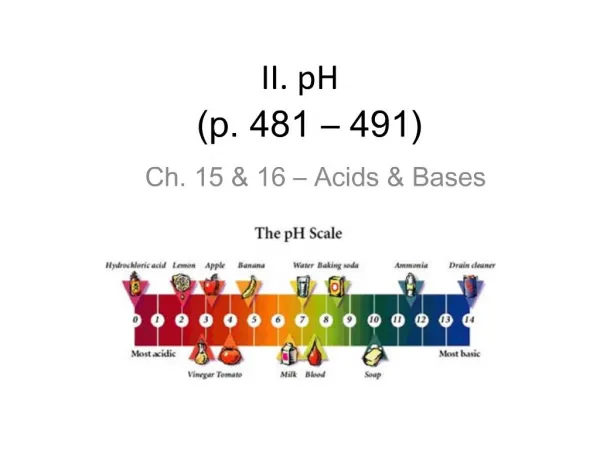
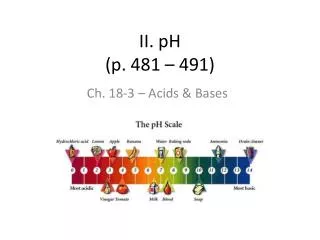
pouvoir hydrogène (Fr.) “hydrogen power” B. pH Scale 14 0 7 INCREASING BASICITY INCREASING ACIDITY NEUTRAL pH = -log[H3O+]
B. pH Scale pH of Common Substances
B. pH Scale - Formulas pH = -log[H3O+] pOH = -log[OH-] pH + pOH = 14
B. pH Scale • What is the pH of 0.050 M HNO3? pH = -log[H3O+] pH = -log[0.050] pH = 1.3 Acidic or basic? Acidic
B. pH Scale • What is the molarity of HBr in a solution that has a pOH of 9.6? pH + pOH = 14 pH + 9.6 = 14 pH = 4.4 pH = -log[H3O+] 4.4 = -log[H3O+] -4.4 = log[H3O+] [H3O+] = 4.0 10-5 M HBr Acidic