Download
1 / 18
220 likes | 294 Vues
Learn how to value bonds, calculate yields, and understand the relationship between market price and bond value. Get insights on prices, yields, and key formulas for bond investing.

E N D
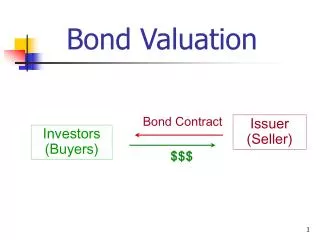
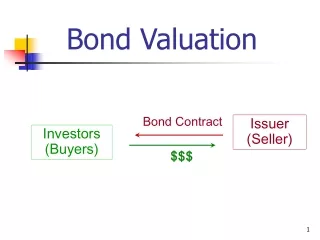
Bond Valuation Bond Contract Issuer (Seller) Investors (Buyers) $ $ $
Bond Contract How much should you pay ? Bond Value = ? Buy the bond today 1 2 3 4 n C C C C C 1 Par 2
Value of Bond today C = Coupon Payment = coupon rate x par Par value or Face Value = $1,000 Bond Value = C (PVIFA i, n) + Par (PVIF i, n) 1 2 3 4 n C C C C C 1 Par 2
An example You buy bond with $1,000 par value, Coupon rate 9% paid once per year, 5 years until maturity. Assume interest rate is 3%. What is the value of this bond? 90 90 90 90 90 1,000 Vb = C x PVIFA i, n + PAR x PVIF i, n 90 x PVIFA 3%,5 + 1,000 x PVIF 3%,5 1,274.77
Find value of bond with $1,000 par value, Coupon rate 15% paid once per year, 4 years until maturity Vb = C (PVIFA i,n) + Par (PVIF i,n) If interest Bond Price • Bond sold at Premium = 10% $ 1,158.49 • Bond is sold at Par = 15% $ 1,000 • Bond sold at Discount = 20% $ 870.61 • Price-Yield relationship
Semiannual coupon payment Coupon per period = coupon per year ÷ 2 Find value of bond with 10% coupon rate paid semiannually, 10 years maturity. Interest rate is 6% Bond Value = C (PVIFA i/2,nx2) + Par (PVIF i/2,nx2) Coupon per period = 10% x 1,000 ÷ 2 = 50 Vb = 50 (PVIFA 3% , 20 ) + 1,000 (PVIF 3% , 20 ) Vb = 50 (14.8775) + 1,000 (0.5537) Vb = 1,297.57
Finding the interest rate (YTM) = coupon per year + [(par – price) ÷ n] (par + price) ÷ 2 ***coupon per year = coupon rate x par ***par = $1,000 ***price = market price ***n = number of years
Finding the interest rate (YTM) = coupon per year + [(par – price) ÷ n] (par + price) ÷ 2 ***coupon per year = 10% x 1000 = $ 100 ***par = $1,000 ***price = $ 850 ***n = 5 years
Finding the interest rate (YTM) = $ 100 + [(1,000 – 850) ÷ 5] (1,000 + 850) ÷ 2 ***coupon per year = 10% x 1000 = $ 100 ***par = $1,000 ***price = $ 850 ***n = 5 years
Finding the interest rate (YTM) = $ 100 + [(1,000 – 850) ÷ 5] (1,000 + 850) ÷ 2 = $ 100 + 30 925 = 0.1405 = 14.05 %
Finding the interest rate (YTM) = $ 160 + [(1,000 – 1,100) ÷ 10] (1,000 + 1,100) ÷ 2 ***coupon per year = 16% x 1000 = $ 160 ***par = $1,000 ***price = $ 1,100 ***n = 10 years
Finding the interest rate (YTM) = $ 160 + [(1,000 – 1,100) ÷ 10] (1,000 + 1,100) ÷ 2 = $ 160 - 10 1,050 = 14.29 % = 0.1429
Exercise 1. A corporate bond with a coupon rate of 7% matures in 4 years. Its price is currently $1,150. - Calculate the current yield on this bond - Calculate the yield to maturity on this bond
Current Yield Formula The current yield refers simply to the annual payment (coupon) divided by the price. Yc = R/P where Yc is the current yield, R is the annual coupon payment in dollars, P is the market price.
Current Yield Example Market price of 5-years treasury bond is $1,020. the bond is paying a coupon of $50 per year. Find the current yield. Yc = 50 1020 Yc = 0.049 or 4.9%
Comparing bond value & market price If the marketprice of Bond < Bond Value Then the Bond is “Cheap” Bond is Undervalued (Underpriced) Investors will buy the Bond Demand > Supply Price will increase
Comparing bond value & market price If the marketprice of Bond > Bond Value Then the Bond is “Expensive” Bond is Overvalued (Overpriced) Investors will sell the Bond Demand < Supply Price will decrease
A bond will have a higher price if: Interest rate (yield) is …………….(higher/lower) Coupon rate, payment is …………….(higher/lower) Maturity is ……….(longer/shorter)