Download

1 / 4
40 likes | 190 Vues
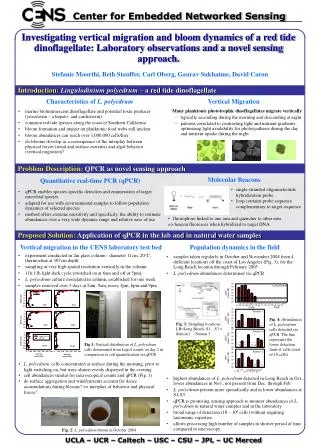
This project addresses the critical need for measuring BTEX (Benzene, Toluene, Ethylbenzene, and Xylene) in water streams at low concentrations (5-50 ppb) using cost-effective methods. Existing technologies are prohibitively expensive, ranging from $50,000 to $200,000. We propose a novel approach utilizing smart materials for sensor design, focusing on polymer selection for analyte enrichment and developing advanced materials with nanoparticle integration. The project aims to optimize spectroscopic detection and deliver a laboratory-based sensing system ready for commercial development.

E N D
Novel Technique for Sensing BTEX Potential PERF/QUESTOR Project
The Issue • Need to measure BTEX in water streams at low levels • Wastewater and Cooling Water • 5 to 50 ppb • Current technologies costly (50 to 200 k$) • Sparger IR or GC; Membrane MS • Enhanced measurement in air for environmental and industrial hygiene also desirable
Novel Approach • Sensors based on smart materials capable of extracting BTEX
Proposal • Objectives: • Selection of polymers for analyte enrichment; • Development of improved materials based on nano-particle doped polymers or sols. • Determination of enrichment profiles (time and concentration) of aromatic compounds • Development and optimization of spectroscopic detection; • Optical design and optimization; • Design of a dedicated laboratory-sensing instrument. • Deliverables: • Novel material design for BTEX determinations • Lab based sensing system ready for commercial development • Principle Investigator: • Dr. Fiona Regan; Dublin City University • Cost: • 80,000 Euro Total • PERF/QUESTOR cost sharing - TBN