QD0 stabilization
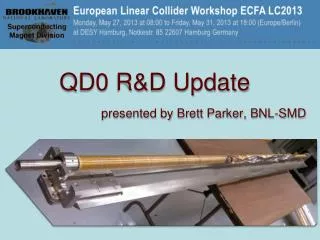
This report presents the advancements in QD0 stabilization methods, showcasing an active table demonstration achieving 0.6 nm RMS @ 4 Hz with one active foot. It covers a range of topics including control integration, sensor comparisons (Guralp and Wilcoxon), and the miniaturization of sensors. The project aims to enhance sensitivity, reduce drift, and improve tolerances. Future work includes thermal analysis, the optimization of actuation mechanisms, and the establishment of industrial partnerships for larger actuator implementation, alongside ongoing simulations and experimental validations.

QD0 stabilization
E N D
Presentation Transcript
QD0 stabilization L. Brunetti1, B. Aimard1, J.-P. Baud1, G. Balik1 , G. Deleglise1, A. Jeremie1, S. Vilalte1 B. Caron2, C. Hernandez2, (LAViSta Team) 1: LAPP-IN2P3-CNRS, Université de Savoie,Annecy, France& 2: SYMME-POLYTECH Annecy-Chambéry, Université de Savoie, Annecy, France
Transfer on a real scale • Demonstration active table to QD0 active control ? 0,6 nm RMS@4Hz One active foot Several active feet • Mecatronics challenge • Structure : QD0 Magnet • Sensors • Actuators • Integration: control, data processing, real time… Schedule : CLIC development phase 2014-06-13 MDI QD0 Stabilisation 2
Sensor • Comparison with Guralp and Wilcoxon: Demonstration sensor • Efficient • Approach validated → patent • Next stage : miniaturization 2014-06-13 MDI QD0 Stabilisation
Sensor • Comparison with Guralp and Wilcoxon: Miniaturized sensor • 2 units have be machined • Still efficient • Control : Accelerometer LAPP sensor Geophone 6T Geophone 3ESP 2014-06-13 MDI QD0 Stabilisation
Sensor • Has to be optimized vs drift, repetitivity, tolerance/sensitivity and one spurious frequency. • Last version, more “industrial” (intermediary prototype vs performances) • Drift: thermal analysis and tests were performed. Problem identified. Study in progress. • Tolerances and tuning are improved → sensitivity x 1,5. The solution will be adapted for the next version. • Spurious frequency : in progress… • Repetitivity: better • New version will be machined • Low cost version • Development of our own electronics and of our own sensitive part… • Valorisation - dissemination 2014-06-13 MDI QD0 Stabilisation
Structure • Objectives: • Modal analysis of short QD0 in order to adapt the simulation of QD0 • Design and simulation of a dummy QD0 to machine a new test bench • Integration of the PZT actuators in the simulation to develop the control laws • Control of this short QD0 2014-06-13 MDI QD0 Stabilisation
Comparison experimental tests and theoretical results… • Clamped magnet: - Experimental analysis - 2nd flexion mode vs y axe 1st torsion mode 2nd flexion mode vs x axe 1st flexion mode vs y axe 1st flexion mode vs x axe 2014-06-13 MDI QD0 Stabilisation
Comparison experimental tests and theoretical results… • Free - free magnet: • Why are there so many differences? • Matter of the 2 blue U, new simulation will be done… • Problem of boundary conditions • In progress: • Control of this short QD0 on our active foot. • New magnet clamping in progress 2014-06-13 MDI QD0 Stabilisation
Design of a dummy structure… • Design and machining of a dummy structure: • Avalaibility to design a dummy structure even if the mode has to be corrected. • Has to be adapted after the short QD0 study will be corrected. • Integration of the PZT actuators in the state space model for the control. 2014-06-13 MDI QD0 Stabilisation
Actuator • No commercial solution for dynamics, resolution, load, stiffness… • Two challenging ways : internal development or industrial partnership… • Industrial solution : PZT actuator • Foreseen collaboration: SYMME, G2Elab, CEDRAT Technologies and LAPP • ANR (French agency) submitted (for 2 years). Pre-proposal ok, final report mid-July… Example of an large actuator Small size PZT actuator • Specifications and tests vs ANR Conceptual views of the future tests benches • The ANR decision is a strategic step for the future of the project… 2014-06-13 MDI QD0 Stabilisation
Conclusion vs QD0 stabilization • Sensor: • A first innovative version has demonstrated the feasibility : performances are about the same as Guralp 6T. • 2 miniaturized versions with our own electronics : still almost the same performance, but small adjustments have to be made (tuning, drift...) • Promising results in control • A “more industrial” version allows to adjust some aspects • A new version will be done. • Advantages: adapted to control, cost, size • Future: sensitivity to magnetic field and tests on an experimental site: first at CERN (stabilization group), then ATF2, CLIC module or CLEX… • Structure: • Analysis has to be corrected… • Actuator: • Partnerships identified and the strategy chosen • ANR decision in July 2014-06-13 MDI QD0 Stabilisation