Download
1 / 11
110 likes | 432 Vues
Protists and Fungi. Chapter 2 Lessons 1 and 2. Protists. Protists Eukaryotes that cannot be classified into any other kingdom Live in moist environments Very diverse Unicellular or Multicellular Heterotrophs or Autotrophs. Characteristics of Animal Like Protists.

E N D
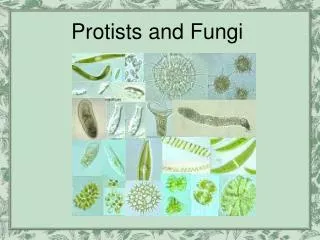
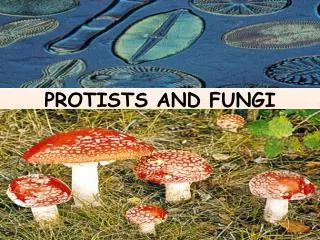
Protists and Fungi Chapter 2 Lessons 1 and 2
Protists • Protists • Eukaryotes that cannot be classified into any other kingdom • Live in moist environments • Very diverse • Unicellular or Multicellular • Heterotrophs or Autotrophs
Characteristics of Animal Like Protists • Protozoans (animal-like protists) • Unicellular • Heterotrophs • Many have a contractile vacuole a structure that collects and expels excess water • Four groups of Protozoans • Sarcodinesmove and feed by forming pseudopods • Temporary bulges of the cell (“false foot”) • Cytoplasm moves towards one location and the rest of the organism follows • Flagellates-move by using whip-like tails • Ciliates-move using cilia • Hair-like projections that beat with a wave-like motion • Parasites-some are flagellates, some are ciliates, some form slime, all live off of one or more hosts
Plant-Like Protists • Algae (Plant-Like Protists) are very diverse • Autotrophs • Unicellular or Multicellular • Contain many different types of pigments-chemicals that produce colors • Important food source in aquatic ecosystems
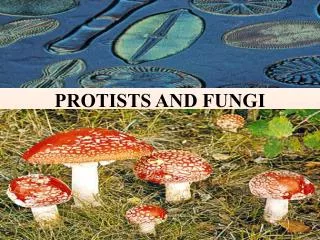
There are Six Types of Plant-Like Protists • Brown Algae • Have many plant like structures • Red Algae • Most are multicelluar seaweed • Diatoms • Unicellular, glasslike cell walls • Green Algae • Dinoflagellates • Unicellular, armored algae • Euglenoids • Green, unicellular algae,eyespot
Fungus-Like Protists • Like animals because they are heterotrophs • Like plants because they havecell walls • Reproduce using spores – tiny cell that is able to grow into a new organism Types of Fungus-like protists • Slime Molds • Water Molds and Downy Mildews
Quick Check • What are plant-like protists called? • Why is sunlight important to plant-like protists? • What are some ways plant-like protists are different from each other? • Are fungus-like protists autotrophic or heterotrophic? • How do fungus-like protists reproduce?
Characteristics of Fungi • Fungi • Heterotrophic eukaryotes with cell walls • Absorb food, and use spores to reproduce • Most fungi have hyphae • Branching tubes that make up the bodies of multicellular fungi • Absorb and transport food • Fungi are typically decomposers or parasites • Hyphae grow into the food then digestive chemicals ooze into the food
Characteristics of Fungi • Fungi reproduce using spores • Fruiting bodies are the reproductive structures where spores are produced Reproduction can be • Asexual • Cells at the tip of the hyphae make spores • Budding-small yeast cell grows from the parent cell • Sexual • Hyphae of two fungi grow together and exchange genetic material
Role of Fungi in Nature • Decomposers • Food Production • Yeast in bread • Mold in blue cheese • Antibiotics-used to kill bacteria • penicillin • Disease Causing • Plants-Corn smut, wheat rust, Dutch elm disease • Animals-Athletes foot, ringworm • Symbiosis • Fungi act as partners with plants to help the plants grow larger • Lichen-partnership between fungus and an algae
Quick Check • What are characteristics that most fungi share? • What are hyphae? • How do fungi reproduce? • How are fungi used to treat disease?