10. Foreign Exchange
420 likes | 558 Vues
This guide provides a thorough understanding of foreign exchange (FX) rates, encompassing the basics, long-term purchasing power parity (PPP), short-term demand and supply influences, and government interventions. Learn how the price of one country's currency in terms of another affects relative import/export prices and the attractiveness of domestic versus foreign assets. Gain insights into market dynamics, including the daily transactions involving USD, nominal and real exchange rates, and their implications on international trade and the economy.


10. Foreign Exchange
E N D
Presentation Transcript
10. Foreign Exchange • The basics • Long run / PPP • Short run / Demand & Supply • Gov’t intervention
Exchange rates (XR) • Price of one countries currency in terms of another • Impacts • Relative prices of imports/exports • Attractiveness of domestic vs. foreign assets
Two ways to quote XR • Foreign currency per 1 US $ • Used to quote • Yen (Japan) • Yuan (China) • Won (S. Korea) • Peso (Mexico) • Rupees (India) • Canadian $
US $ per 1 unit of foreign currency • Euro • British Pound
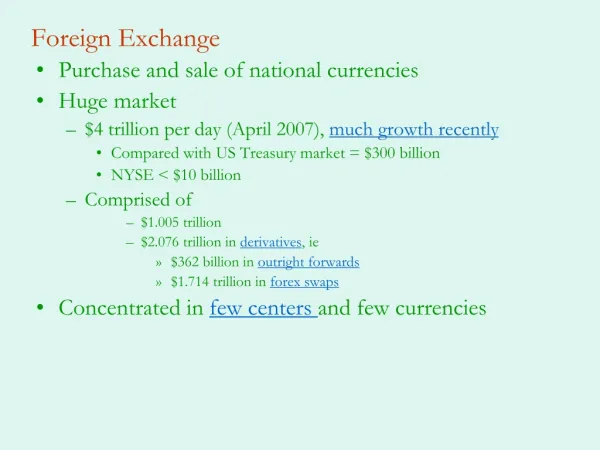
XR market • Worldwide market • $1 trillion in transactions daily • 90% involve US $ • Size of economy • Store of value • World price of oil in US $
Nominal XR • Rate of one country’s currency exchanges for another
US $ Depreciation • US $ buys less of foreign currency • 2000-2008 • Canada, Euro, UK, China . . . • Most major trading partners • US $ has fallen • US $ is weaker
US $ appreciation • US $ buys more of foreign currency • 2000-2008 • Mexico • US $ has risen • US $ is stronger
Example: Yen/$ • If $ appreciates, the Yen must depreciate • XR are a “seesaw” • XR changes have winners and losers
Real XR • Relative cost of certain goods in two countries • Changes in the nominal XR
Example: U.S. $ vs. Can $ • SUNY tuition, nonresident • Fall 2000: $4150/sem • Fall 2007: $5305/sem • The finest system of public higher ed in the nation: priceless • XR • Fall 2000: $1.50 C$ per 1 US $ • Fall 2007: $1.10 C$ per 1 US $
How much is tuition to a Canadian student? • Convert US $ tuition to Can $ • 2000: 4150(1.50) = C$ 6225 • 2007: 5305(1.10) = C$ 5835.50 • Can $ appreciation means an actual fall in tuition for Canadian students
U.S. $ depreciation • Imported goods more expensive • Less purchasing power abroad • Exports less expensive abroad • Foreign visitors have more purchasing power
Univ of W. Ontario, nonresident • Fall 2000: C$ 5190/sem • Fall 2007: C$ 7300/sem • Tuition costs for a U.S. student • 2000: 5190/1.5 = $3460 • 2007: 7300/1.1 = $6636
XR in the long run • Primarily depends on relative inflation • Law of One Price • Identical goods should be about the same price everywhere in the world
Pack of gum • If $1 = 115 yen • Then gum should cost $1 in U.S. and 115 Y in Japan
Now suppose prices double in US, so gum is $2. • At the XR of 115Y/$, gum is cheaper in Japan • Gum is 115Y or $1 in Japan • Run on gum in Japan
To equalize things, • XR moves: $ must depreciate • 57.5Y/$ then gum is same price
Purchasing power parity (PPP) • XR adjust to relative price changes in two countries, so law of one price holds • If US inflation is higher than other countries • $ depreciate • If lower, then $ appreciates
Does PPP hold? • In the long run, yes • In the short run, no way • Big Mac Index (240-41) • Not all goods identical or traded across countries
Other LR factors • Trade barriers—tariffs/quotas • Boost domestic demand • $ appreciates • Productivity -- GDP/labor hour • Higher relative productivity in US • $ appreciates
XR in the Short Run • Supply and Demand, US $ • Explains short term volatility
Who supplies $ to XR market? • People buying foreign goods • People investing in foreign assets • As $ appreciates (Price of $ rises) • People buy more foreign goods because they are cheaper • Supply slopes up
E/$ Q of $ S
Who demands $ in XR market? • People wanting to buy U.S. goods or dollar assets • As $ depreciates (Price of $ falls) • People buy more US goods because they are cheaper • Demand slopes down
E/$ Q of $ S D
What causes the $ to depreciate? • An increase in the supply of $ • A decrease in the demand for $
What increases $ supply? • Increase in preference for foreign goods • An increase in US GDP and income • Buy more imports • An increase in real interest rate on foreign bonds relative to US OR decrease in relative foreign investment risk • Investors supply more $ to buy them • Expectation of $ depreciation • People supply $ now
What decreases $ demand? • Decrease in preference for US goods in foreign countries • A decrease in foreign GDP/income • A decrease in real interest rate OR increase in relative risk of U.S. bonds and investments • An expected depreciation of the $
E/$ S’’ Q of $ Increase in $ supply S D
E/$ D’’ Q of $ Decrease in $ demand S D
So what is causing $ depreciation? • Trade deficit • US imports > US exports As $ depreciates, this will narrow the trade deficit • Federal deficit • World market believes the US borrows too much?
Consequences? • The good: • Rising US exports • Tourism in US • Less pressure for trade barriers
The bad: • Possible inflation (higher import prices) • US tourists abroad • US debt less attractive • Pressure to move oil pricing to Euros
Government Intervention • Can the government affect XR markets? • Yes, but interventions are rare • Only effective if nations cooperate, scale is large • At best interventions are short run solutions