Understanding the Shift from High School to Higher Education: Challenges and Opportunities
70 likes | 191 Vues
Transitioning from high school to higher education involves significant changes in structure, expectations, and personal responsibility. High school typically features a rigid schedule, teacher-guided learning, and a focus on rules, whereas college offers a more flexible, self-directed learning environment. This shift can lead to common fears such as academic pressure, loneliness, and uncertainty about one's path. It's essential to embrace this transition as it presents opportunities for personal growth, increased income potential, and the development of lifelong skills.


Understanding the Shift from High School to Higher Education: Challenges and Opportunities
E N D
Presentation Transcript
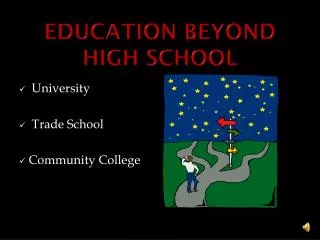
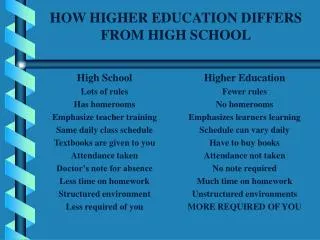
High School Lots of rules Has homerooms Emphasize teacher training Same daily class schedule Textbooks are given to you Attendance taken Doctor’s note for absence Less time on homework Structured environment Less required of you Higher Education Fewer rules No homerooms Emphasizes learners learning Schedule can vary daily Have to buy books Attendance not taken No note required Much time on homework Unstructured environments MORE REQUIRED OF YOU HOW HIGHER EDUCATION DIFFERS FROM HIGH SCHOOL
WHAT VALUES ARE:Your values are the truest expression of who you are • A value is an important attitude • A value is a matter on which you take action • A value should be consciously chosen
COMMON FEARS OF COLLEGE STUDENTS • Fear of flunking out—this may be the biggest • Fear of not being able to manage everything • Fear of the pressure—of the work and responsibility, of not being able to compete • Fear of loneliness, of not finding supportive friends • Fear of not finding one’s way around • Fear of running out of money
Why Do Some People Have Trouble With Higher Education? • They are underprepared academically, which leads to frustration • They are overprepared academically, which leads to boredom • They perceive college as being not useful • They have unrealistic expectations about college • They are uncertain about their major or career • No money for tuition and books • Classes being given at inconvenient times • No time off from work
How Could College Make a Difference in Your Life? • The more education, the more income • Increased personal development • Increase in knowledge, competence, and self-esteem • Increase in personal • INCREASED HAPPINESS
The Strengths That Give You Staying Power • Sense of personal control and responsibility • Optimism • Creativity • Ability to take psychological risks
3 Stage Scale For Active Learning • Stage 1 learning-memorization • Stage 2 learning-comprehension • Stage 3 learning- applying, analyzing, synthesizing, evaluation