Software Specification KXA233 Lecture 10 Object-Oriented Design Chapter 21
Software Specification KXA233 Lecture 10 Object-Oriented Design Chapter 21. Paul Crowther School of Computing University of Tasmania. Today. Object Oriented Design Subsystem considerations. Responsibility design. Message design. Class and Object Design. Subsystem design.

Software Specification KXA233 Lecture 10 Object-Oriented Design Chapter 21
E N D
Presentation Transcript
Software SpecificationKXA233Lecture 10Object-Oriented DesignChapter 21 Paul Crowther School of Computing University of Tasmania
Today... • Object Oriented Design • Subsystem considerations
Responsibility design Message design Class and Object Design Subsystem design Design for Object oriented Systems • Subsystem layer • Class and object layer • Message layer • Responsibility layer
Operations Attributes Object- Relationship Model Collaborators CRC Index Cards Responsibility design Use Cases Message design Object- Behaviour Model Class and Object Design Subsystem design OOA to OOD
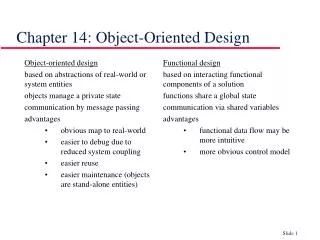
Conventional v OO Approaches • Representation of hierarchy of modules • Specification of data definitions • Specification of procedural logic • Indication of end - end processing sequences • Representation of object states and transitions • Definitions of classes and hierarchies • Assignment of operations to classes • Detailed definition of operations • Specification of message connections • Identification of exclusive services
Design Issues • Decomposability • break a problem into smaller problems • Composability • program components can be reused • Understandability • Continuity • Protection
Design Issues - Design Principles • Linguistic modular units • Few interfaces • Small interfaces(weak coupling) • Explicit interfaces • Information hiding
OOD Landscape - Booch • Architectural Planning • Tactical design • Release Planning
OOD Landscape - Coad- Yourdon • Problem domain component • Human interaction component • Task management component • Data management component
Coad- Yourdon Problem Domain Component • Group all domain specific classes • Design an appropriate class hierarchy • Work to simplify inheritance where appropriate • Refine design to improve performance • Develop an interface with data management component • Refine and add low-level objects as required
Coad- Yourdon Human Interaction Component • Define human actors • Develop task scenarios • Design hierarchy of user commands • Refine the user interaction sequence • Design relevant classes and class hierarchy • Integrate GUI classes as appropriate
Coad- Yourdon Task Management Component • Identify types of tasks (event / time driven) • Establish priorities • Identify coordinator tasks (of other tasks) • Design appropriate objects for each task
Coad- Yourdon Data Management Component • Design the data structures and layout • Design the services required to manage the data structures • Identify tools to assist in implementing data management • design appropriate classes and class hierachy
OOD Landscape - Jacobson • Consider adaptions to make the analysis model fit the real world environment • Create blocks (aggregated objects) as the primary design object • Define a block to implement related analysis objects • Identify interface, entity and control blocks • describe block communication during execution • Identify stimuli between blocks and their order • Create an interaction diagram • Organise blocks into subsystems
OOD Landscape - Rambaugh • Perform system design • Conduct object design • Implement control mechanisms • Adjust class structure to strengthen inheritance • Design messaging to implement object relationships • Package classes into modules
Generic Components of OOD • Describe each of the subsystems in a manner that is implementable • allocate subsystems to tasks • choose a design strategy • design controls • Object design • design operations at the procedural level • define any internal classes • design internal data structures for class attributes • Message design • Review and redesign as appropriate
Partition the Analysis Model • Subsystem should have a well defined interface • Classes within a subsystem should collaborate only with other subclasses in the subsystem • Exception is a small number of communication classes • The number of subsystems should be kept small • Internally partition subsystems to reduce complexity • Communication between subsystems should be client/server or peer-to-peer
Concurrency and Subsystem Allocation • Can more than one object be active at one time? • If so concurrent processing is possible • Thread of control - where one object sends a message to another, then waits for a response. • Tasks are designed by isolating threads of control
Task Management • Strategy for managing concurrent tasks • Characteristics of the task are determined • The coordinator task and associated objects are defined • The coordinator and other tasks are integrated • Tasks • event driven • time driven
Task Management Template • Task name • Description • Priority • Services • Coordinated by • Communicates via • Incorporate into the design model for task objects
Data Management • Management of data critical to the object • Creation of infrastructure for storage and retrieval of objects • Isolate • lower level requirements for manipulating data structures • higher level requirements for handling system attributes • DBMS often used as common data store - objects to manipulate • members of reusable classes identified during analysis • classes supplied by the DBMS vendor
Data Management • Design includes design of attributes and operations to manage objects • Append to every object information about: • How do I store myself? • Create an object-server class (Coad & Yourdon) with services to: • tell each object to save itself • retrieve stored objects for use by other components
Human-Computer Interface GUI • Use-cases • usage scenarios • actors • Serve as input to HCI design process • Once an actor an usage scenario defined: • command hierarchy identified • this defines the major system menu categories (toolbar) • subfunctions (menu windows)
Inter-Subsystem Communication • Use object to object collaboration model • peer-to-peer • client/server • List each request that can be made by collaborators of the subsystem and organise them by subsystem • Define the model type • Note the operations required to implement the responsibilities of the model type
Inter-Subsystem Communication • Note for each case: • Type of model • (client/server or peer-to-peer) • Collaborators • which subsystem(s) • Class • names of classes required to support services • Operation • names of operations required to support services • Message format • Draw a subsystem collaboration graph
Object Design Process • Object description • protocol description • implementation description • Algorithms and data structures • Program Components and Interfaces • All this needs to be part of the Object Specification
Next week... • OO specification details • OO testing