Download
1 / 4
40 likes | 156 Vues
This article explores the history of polychlorinated biphenyls (PCBs) from their global production in the 1930s to the 1980s, including U.S. output of 600,000 tons. We discuss regulatory measures introduced in the 1970s and 1980s, highlighting strict standards for the Spokane River. PCBs’ low vapor pressure and particle adhesion effects are examined, as well as their transportation in air. Lastly, we review various cleanup methods, such as incineration, microbial remediation, and chemical cleaning to mitigate PCB contamination.

E N D
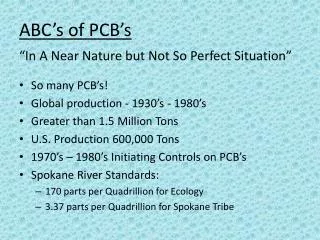
ABC’s of PCB’s “In A Near Nature but Not So Perfect Situation” • So many PCB’s! • Global production - 1930’s - 1980’s • Greater than 1.5 Million Tons • U.S. Production 600,000 Tons • 1970’s – 1980’s Initiating Controls on PCB’s • Spokane River Standards: • 170 parts per Quadrillion for Ecology • 3.37 parts per Quadrillion for Spokane Tribe
Transport Into the Environment • PCB’s have a low vapor pressure allowing water to Dissolve PCB’s • PCB’s have an ability to grasp particles • Air transportation of PCB’s especially those simpler forms with/1-4 chlorine atoms • Ventilation of PCB’s containing air from buildings
Getting Rid of PCB’s • Incineration • Microbial • Chemical
Cleaning PCB’s Up Pictures of Our Vactors