Tackling Pigweed Challenges in Georgia: Insights from 2004
In 2004, pigweed, particularly Palmer amaranth, emerged as a formidable weed in Georgia agriculture. This report explores key factors contributing to the problem, such as species adaptability, reduced use of effective herbicides, and challenges associated with crop rotations and tillage practices. With a prolific seed production rate and faster growth compared to other pigweed species, Palmer amaranth has become increasingly difficult to manage. The document highlights identification resources, control methods, and emphasizes the importance of timely herbicide application and crop management strategies.

Tackling Pigweed Challenges in Georgia: Insights from 2004
E N D
Presentation Transcript
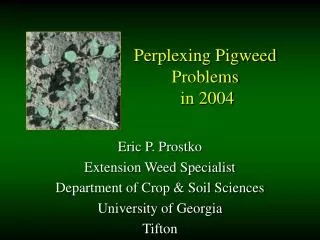
Perplexing Pigweed Problems in 2004 Eric P. Prostko Extension Weed Specialist Department of Crop & Soil Sciences University of Georgia Tifton
Why such a problem? • species • timing • a decline in DNA and Cotoran use in cotton • reduced tillage • reduced rates of Cadre in peanut • crop rotations • resistance issues
Common Pigweed (Amaranthus) Species in GA Palmer Slender Spiny Redroot Smooth Photos: SWSS Weed ID Guide
Why Palmer Amaranth? • grows faster than other pigweeds • more competitive than other pigweeds • prolific seed producer • 1,000,000 seeds/plant • 9-12 WAE • 2 generations/year • herbicide tolerance
Pigweed Response To Herbicides • “Palmer amaranth more difficult to control than smooth” • Gossett and Toler (1999), Weed Technology 13:165-168 • “Pendimethalin and trifluralin controlled Palmer amaranth, redroot pigweed, and tumble pigweed less than other herbicides” • Sweat et al. (1998), Weed Technology 12:315-321 • “Significant differences in herbicide control among pigweed species. Palmer amaranth is more difficult to control.” • Mayo et al. (1995), Weed Technology 9:141-147
Pigweed Identification Sources • Identification of the Weedy Pigweeds and Waterhemps of Iowa • http://www.weeds.iastate.edu/weed-id/waterhemp/default.htm • Pigweed Identification: A Pictorial Guide to the Common Pigweeds of the Great Plains • http://www.oznet.ksu.edu/library/crpsl2/s80.pdf
Palmer Amaranth Control with Blazer Applied at Different Timings Source: Mayo et al., 1995 Weed Technology 9:141-147
Pigweed Control in RR Soybeans SB-01-04 August 3, 2004 105 DAP EPOST = 2-4” AMAPA (21 DAP) LPOST = 9-10” AMAPA (30 DAP) Sequence 5.25 EW (22 ozs/A) LSD 0.05 = 13
Pigweed Control with Roundup WM @ 22 ozs/A Untreated EPOST (21 DAP) LPOST (30 DAP) SB-01-04 June 24, 2004 56 DAP
Herbicides Used in GA Cotton Source: USDA Agricultural Chemical Usage Reports
Weed Control ChallengesStrip-Tillage • yellow herbicide application method • split applications • higher rates • impregnated • Prowl H20? • Before or after strip-till rig • more work is needed in this area
Cadre Rate Dilemma • 64% of peanut acres • labeled use rate is 1.44 ozs/A • many growers using 1.0 ozs/A • cotton rotation is critical
Corn Production in GeorgiaAcres Planted Source: GA Crop Estimates (http://www.nass.usda.gov/ga/cropests/cornall.txt)
Crop Rotations in GAIrrigated Peanuts Following Corn/Grain Sorghum or Cotton Source: UGA Extension Agent Surveys
Herbicide Resistant Pigweed Issues • could be more of a problem than we think • DNA/IMI resistant pigweed in SC • IMI/ALS resistant pigweed in Burke County, GA • no confirmed pigweed resistance to glyphosate anywhere in world ? • Waterhemp in IA and MO
Final Thoughts • resistant weed surveys • weed control in reduced tillage systems • timing, timing, timing • use residual herbicides in problem fields • full rates of Cadre on difficult species • corn rotations if profitable