Download
1 / 12
120 likes | 237 Vues
This chapter explores the significance of studying primates to understand human evolution. It highlights key aspects such as homology and analogy, revealing how adaptations in primates provide insights into the evolutionary history of humans. Derived traits like opposable thumbs, enhanced sight, and brain size are discussed. The chapter distinguishes between prosimians and anthropoids, detailing various species, their social structures, and adaptations. The close genetic relationship between chimpanzees and humans is emphasized, showcasing the importance of primate studies in anthropology.

E N D
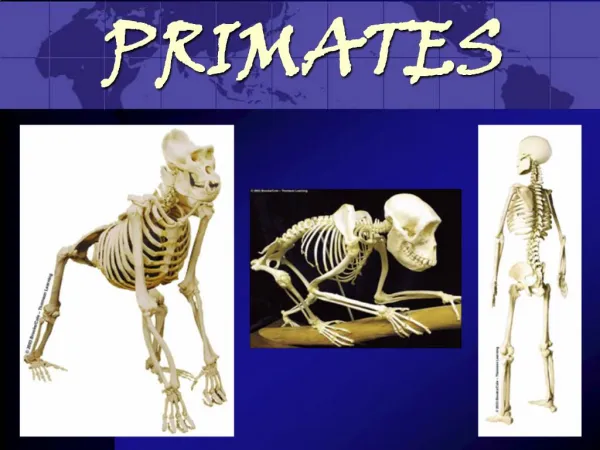
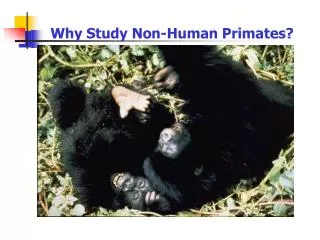
Chapter 5: Introduction to the Primates • Why do anthropologists study primates? • To understand human evolution by: • Homology • The same adaptations in close relatives offer clues to design structures in ancestral and contemporary human populations (culture?) • Analogy • How do other primates respond to the same and different environmental pressures?
Derived Traits • Opposable Thumbs • Nails (no claws) • Hind limb dominated locomotion • Reduced sense of smell • Increase importance of sight (stereoscopic vision) • Small litters • Large Brain • Unspecialized teeth
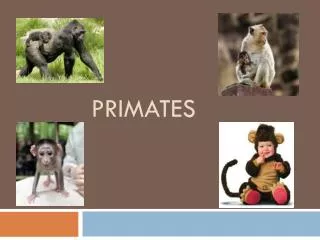
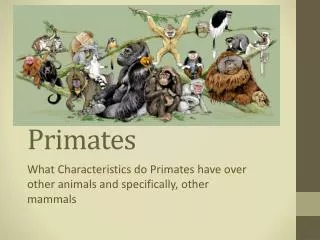
Two types (suborder): • Prosimians: VCL, Lemurs (Madagascar), Aya-ayes, Lorises, & Galagos. • Anthropoides: Old and New World Monkey and Apes (humans) (see table 5-3)
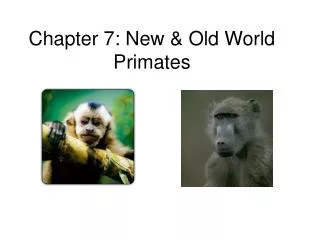
New World Monkeys • Marmosets and tamarins (small bodied) • Twins • Polyandry • Monogamous families with alloparental care • Others: • Howlers • Spider • Wooly • Squirrel • Capuchins (tool users) • Night monkeys (owl monkey) • others
Old World Monkeys • Colobus & Lagurs (harems) • Macaques, baboons & vervets (multi-male and multi-female, female phylopatry) • Apes • Lack tails • Bigger brains • Y-Shaped pattern on lower molar
Lesser apes: Gibbons and Siamangs (Asia, brachiators, Monogamous)
Great Apes: • Gorilla (Africa, polygamous harems)
Orangutans (Asia, solitary, home range, rape )
Common Chimps (Africa, promiscuous, multi-male and multi-female)
Bonobos “Pygmy Chimps” (Africa, very promiscuous, multi-male and multi-female, matriarchal)