Essential Sources for Effective Research in 8th Grade: A Guide to Information Access
This guide explores the various types of sources available for effective research in 8th grade. It covers primary and secondary sources, including encyclopedias, dictionaries, thesauruses, periodicals, almanacs, atlases, directories, and personal interviews. Understanding how to locate and utilize these resources is key to developing relevant research questions and gathering pertinent information. Consider this framework to enhance your research skills and critical thinking, enabling you to access diverse and reliable information for your academic projects.

Essential Sources for Effective Research in 8th Grade: A Guide to Information Access
E N D
Presentation Transcript
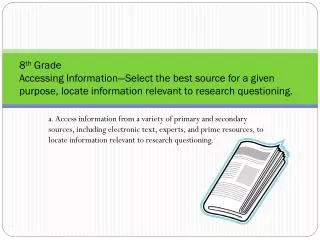
8th GradeAccessing Information—Select the best source for a given purpose, locate information relevant to research questioning. a. Access information from a variety of primary and secondary sources, including electronic text, experts, and prime resources, to locate information relevant to research questioning.
The sources • Encyclopedia: book or set of books containing articles on various topics, usually in alphabetical arrangement, covering all branches of knowledge or, less commonly, all aspects of one subject. • Dictionary: Book that gives the meaning of words as well as pronunciations. Some specialized dictionaries can help you learn about words relating to a particular subject. • Thesaurus: a dictionary with synonyms and antonyms. • Periodicals include magazines, newspapers, scientific journals, and other materials that are published daily, weekly, or monthly. • Almanac: A usually annual reference book composed of various lists, tables, and often brief articles relating to a particular field or many general fields. • Atlas: A book of maps. It may also contain information about a land region, such as its climate and terrain, latitude and longitude, topography, population figures, elevations, settlement patterns, agricultural patterns, and transportation routes. • Directory: a list of information with names and addresses, like a fan club list. • People: great sources of oral history and people are primary sources.
Searching for information: Key words • Key words: Entries in encyclopedias are arranged alphabetically by key words. • Try to narrow the focus of your search by beginning with the most specific key word. (For example, rock music will be listed under R, because the key word is rock.) If the word you choose is too specific, broaden your focus a little at a time.
Standard 5.1a: Access information from a variety of primary and secondary sources, including electronic text, experts, and prime resources, to locate information relevant to research questioning.
Standard 5.1a: Access information from a variety of primary and secondary sources, including electronic text, experts, and prime resources, to locate information relevant to research questioning. Encyclopedias vs. Almanacs
Standard 5.1a: Access information from a variety of primary and secondary sources, including electronic text, experts, and prime resources, to locate information relevant to research questioning.
Standard 5.1a: Access information from a variety of primary and secondary sources, including electronic text, experts, and prime resources, to locate information relevant to research questioning.