Future Trends Prescriptive AI Solutions in Smart Manufacturing
0 likes | 0 Vues
Discuss the future of Prescriptive AI Solutions, including AI-assisted decision making, continuous optimization, and the shift from reactive to prescriptive maintenance strategies to achieve peak plant performance.


Future Trends Prescriptive AI Solutions in Smart Manufacturing
E N D
Presentation Transcript
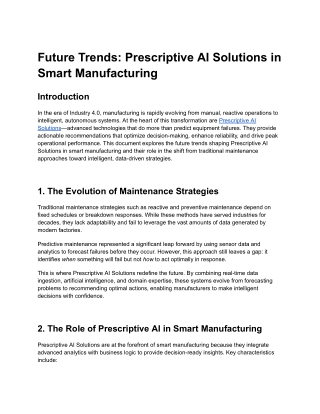
Future Trends: Prescriptive AI Solutions in Smart Manufacturing Introduction In the era of Industry 4.0, manufacturing is rapidly evolving from manual, reactive operations to intelligent, autonomous systems. At the heart of this transformation are Prescriptive AI Solutions—advanced technologies that do more than predict equipment failures. They provide actionable recommendations that optimize decision-making, enhance reliability, and drive peak operational performance. This document explores the future trends shaping Prescriptive AI Solutions in smart manufacturing and their role in the shift from traditional maintenance approaches toward intelligent, data-driven strategies. 1. The Evolution of Maintenance Strategies Traditional maintenance strategies such as reactive and preventive maintenance depend on fixed schedules or breakdown responses. While these methods have served industries for decades, they lack adaptability and fail to leverage the vast amounts of data generated by modern factories. Predictive maintenance represented a significant leap forward by using sensor data and analytics to forecast failures before they occur. However, this approach still leaves a gap: it identifies when something will fail but not how to act optimally in response. This is where Prescriptive AI Solutions redefine the future. By combining real-time data ingestion, artificial intelligence, and domain expertise, these systems evolve from forecasting problems to recommending optimal actions, enabling manufacturers to make intelligent decisions with confidence. 2. The Role of Prescriptive AI in Smart Manufacturing Prescriptive AI Solutions are at the forefront of smart manufacturing because they integrate advanced analytics with business logic to provide decision-ready insights. Key characteristics include:
AI-Assisted Decision Making Prescriptive AI doesn’t just report anomalies; it suggests concrete actions. For example: ● Recommending adjustments to machine settings to avoid imminent failure. ● Prioritizing maintenance tasks based on severity, cost impact, and production schedules. ● Providing root-cause analysis and corrective steps rather than just highlighting symptoms. This enables faster responses to operational issues and empowers plant personnel with insights that were previously hidden or accessible only to experts. Continuous Optimization Unlike static rule-based systems, Prescriptive AI Solutions learn and improve over time. Through machine learning algorithms and feedback loops, these systems: ● Adapt recommendations based on real outcomes and evolving operational patterns. ● Automatically refine maintenance plans to lower costs and improve machine availability. ● Optimize energy usage and production efficiency by analyzing multi-factor constraints (e.g., throughput, load, temperature). Continuous optimization becomes a competitive advantage, allowing manufacturers to stay agile in rapidly changing environments. 3. From Reactive to Prescriptive: A Paradigm Shift The transition from reactive to prescriptive maintenance marks a fundamental change in how manufacturing operations are managed: Maintenance Type Core Focus Outcome Reactive Respond after failure High downtime & costs Preventive Time-based maintenance Overhead & unnecessary repairs Predictive Failure forecasting Reduced unplanned downtime
Prescriptive (Future) Actionable recommendations Optimized operations, reduced costs, increased uptime Prescriptive AI Solutions complete the evolutionary cycle by combining prediction with recommendation and prioritization. Instead of waiting for alarms, manufacturers can now confidently act ahead of disruptions and align actions with strategic goals. 4. Integration with Smart Systems & IIoT Future implementations of Prescriptive AI will be tightly integrated with Industrial Internet of Things (IIoT) systems, creating a seamless flow of data across: ● Sensors and edge devices ● Cloud platforms ● Manufacturing execution systems (MES) ● Enterprise resource planning (ERP) systems This integration enables real-time intelligence, cross-system coordination, and end-to-end visibility—opening the door to intelligent automation and self-optimizing factories. 5. Benefits of Prescriptive AI Solutions for Manufacturers By embracing Prescriptive AI Solutions, manufacturers can expect: Maximized Equipment Performance AI-generated recommendations ensure machines operate at peak efficiency while reducing wear and tear. Reduced Downtime and Maintenance Costs Targeted actions minimize unnecessary servicing, reduce unplanned stoppages, and extend asset life. Improved Decision Making
Operators and managers gain confidence through AI-backed decisions supported by data and historical patterns. Enhanced Operational Agility Manufacturers can respond quickly to changing conditions, supply chain disruptions, and production variability. 6. Future Outlook As data ecosystems grow more sophisticated and AI technologies improve, Prescriptive AI Solutions will become essential to competitive manufacturing. Anticipated future trends include: ● Autonomous Manufacturing Operations: Systems that not only recommend, but also execute decisions with minimal human intervention. ● Cognitive AI Engines: AI models that understand complex production environments and simulate outcomes before recommending actions. ● Cross-Operational Intelligence: Prescriptive recommendations that consider enterprise-wide goals such as sustainability, cost optimization, and throughput. The strategic adoption of Prescriptive AI Solutions will enable manufacturers to transition from traditional factories to intelligent, self-optimizing enterprises. Conclusion Prescriptive AI Solutions represent the next frontier in smart manufacturing. By pushing beyond prediction into actionable optimization and automation, these systems empower manufacturers to achieve unprecedented reliability, efficiency, and agility. The future of industrial operations is not just connected—it is intelligent, adaptive, and prescriptive.