Download
1 / 14
140 likes | 256 Vues
Effective note-taking is essential for success in lectures and presentations. Begin by staying alert and identifying the speaker's purpose. Ask why the information matters and how it links to the main idea. Listen for central themes instead of isolated facts and engage actively by taking notes and asking questions. Recognize key words and points that signify important information. Organize your notes according to lecture structure using methods like the Cornell system, mapping, or charting. Personalize your notes for better retention and comprehension.

E N D
Effective Note-Taking Begins with Staying Alert • To stay alert: • Identify speaker’s purpose: is it to persuade, inform? • Ask yourself ‘Why is this information important?’ and ‘How is it related to the speaker’s purpose…to the main idea? • Listen for central themes rather than isolated facts. • Stay active – take notes, ask questions. • Relate the subject to something in life to make it relevant and interesting.
Actual Note-Taking You mustbe able to distinguish important information from unimportant information.
Key Words These signal that the information to follow is important and should be recorded. Key words are content-related, or can be transition words & phrases/discourse markers.
Content Key Words These relate directly to the subject matter. Ex. – Content key words in a history class might be the names of U.S. presidents from 1920 – 1948.
Transition Words & Pharases/Discourse Markers These indicate that important information is forthcoming. Ex. – ‘Next’, ‘above all’, ‘in addition to’
Key Points Key points in a lecture often correspond to chapter headings or headings from an assigned reading. Bring a list of headings to class and listen for them during the lecture.
Cues & Clues • Pay attention to gestures. • Anything written on the board is important! • Listen for changes in the instructor’s voice. • When important information is being presented, the instructor’s voice often becomes higher in pitch or rate of speech increases.
Organizing Notes In general, your notes should be organized in accordance with how the lecture is organized. Organization is highly dependent on learning styles and personal preference. You have to find out what works for you!
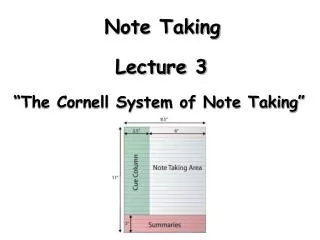
Cornell Method http://lsc.sas.cornell.edu/Sidebars/Study_Skills_Resources/cornellsystem.pdf
Outlining • The most general information is placed at the left, with each more specific group of facts indented to the right. • Ex. – • Advantages of agriculture • More efficient land use a. 1 sq km of land supports 50 people. • More stable food source
Mapping This is a graphic presentation. Can help maximize active participation in a lecture. Useful when you don’t know how the lecture is going to be presented.
Charting Method If the lecture format is distinct (such as chronological0, you may set up your paper by drawing columns and labeling appropriate headings in a table.
Using Your Notes • Note Think • Read your notes and try to personalize the information. • Consider how personal experiences relate to the information. • Consider how the notes might be useful to you. • Record perceptions. • Color Coding • Distinguish different types of information by highlighting notes with different colors.