IE 2030 Lecture 11 Introduction to System Dynamics
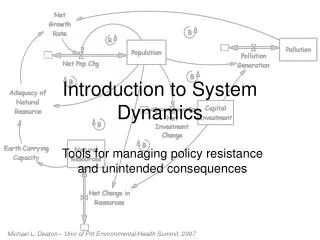
IE 2030 Lecture 11 Introduction to System Dynamics. System Dynamics. Another descriptive model Gives qualitative predictions and insights Software tools exist (STELLA) Main text: The Fifth Discipline by Senge

IE 2030 Lecture 11 Introduction to System Dynamics
E N D
Presentation Transcript
System Dynamics • Another descriptive model • Gives qualitative predictions and insights • Software tools exist (STELLA) • Main text: The Fifth Discipline by Senge • Senge’s book is on the non-technical, teaching side of the spectrum -one response to Dark Side
IE 2030 Lecture 11Today’s Core Concepts • Cause and Effect thinking, Influence or Causal Loop Diagrams • Feedback • Positive Feedback • Negative Feedback • Delay in Feedback Loops
Cause and Effect • Draw an arrow from cause to effect • ``Influence’’ or ``affect’’ may be a better term than “cause.” • Examples
Influence Diagrams • Place a “+” or a “-” at the arrow to indicate the kind of influence + means: the more of one, the more of the other (or less…less) - means: the more of one, the less of the other (or less…more)
Feedback Loops • Any directed cycle is afeedback loop • The arrows must take you back to where you started • Feedback makes systems complicated! • Examples
Principle: the most important causal influences are those that are within feedback loops
POSITIVE Even # of - signs Amplifying Reinforcing Growth, but also Decline Unstable NEGATIVE Odd # of - signs Balancing Stabilizing Often good! Stable equilibria Two Kinds of Feedback
Feedback Examples • A pencil falls • Standing on one foot
Delay • Taking a shower • Carrying a cup of coffee • Timing very important • Beer game, supply chains • Classic problem: when short-term influence is of one type, and long-term influence is of the other type
Administrative • Homework (old, new) • Project to turn in • New project: 1b, cashier validation • Data collection projects for sr. design • Spring break