Download
1 / 1
10 likes | 122 Vues
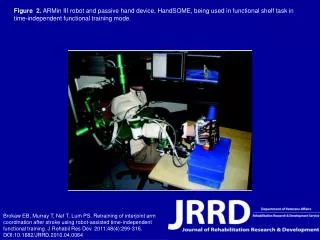
This study by Brokaw et al. examines the effectiveness of using the ARMin III robot and the HandSOME passive hand device in a time-independent functional training mode for retraining interjoint arm coordination in stroke survivors. The research aims to improve arm function through functional shelf tasks, highlighting advancements in rehabilitation technologies and approaches. The findings indicate the potential for these robotic devices to enhance recovery and coordination, offering valuable insights into post-stroke rehabilitation strategies.

E N D
Figure 2. ARMin III robot and passive hand device, HandSOME, being used in functional shelf task in time-independent functional training mode. Brokaw EB, Murray T, Nef T, Lum PS. Retraining of interjoint arm coordination after stroke using robot-assisted time-independent functional training. J Rehabil Res Dev. 2011;48(4):299-316.DOI:10.1682/JRRD.2010.04.0064