
Expansile Nanoparticles for pH-Triggered Intracellular Paclitaxel Delivery
This study explores the design and synthesis of expansile nanoparticles (eNPs) for targeted drug delivery of paclitaxel (Pax) in cancer treatment. Utilizing a pH-triggered mechanism, these eNPs exhibit swelling at acidic pH (5), enhancing intracellular drug concentration within breast cancer cells (MD-MBA-231) compared to traditional nanoparticles. The study demonstrates improved cytotoxicity through the enhanced drug delivery system, offering promising advancements in chemotherapy efficacy. Additionally, the project engaged high school students in hands-on nanotechnology via community outreach initiatives.

Expansile Nanoparticles for pH-Triggered Intracellular Paclitaxel Delivery
E N D
Presentation Transcript
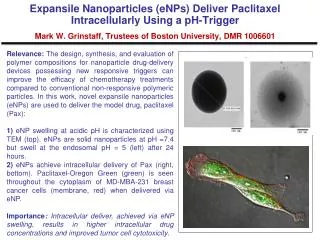
Expansile Nanoparticles (eNPs) Deliver Paclitaxel Intracellularly Using a pH-TriggerMark W. Grinstaff, Trustees of Boston University, DMR 1006601 Relevance: The design, synthesis, and evaluation of polymer compositions for nanoparticle drug-delivery devices possessing new responsive triggers can improve the efficacy of chemotherapy treatments compared to conventional non-responsive polymeric particles. In this work, novel expansile nanoparticles (eNPs) are used to deliver the model drug, paclitaxel (Pax): 1) eNP swelling at acidic pH is characterized using TEM (top). eNPs are solid nanoparticles at pH =7.4 but swell at the endosomal pH = 5 (left) after 24 hours. 2) eNPs achieve intracellular delivery of Pax (right, bottom). Paclitaxel-Oregon Green (green) is seen throughout the cytoplasm of MD-MBA-231 breast cancer cells (membrane, red) when delivered via eNP. Importance: Intracellular deliver, achieved via eNP swelling, results in higher intracellular drug concentrations and improved tumor cell cytotoxicity.
Expansile Nanoparticles (eNPs) Deliver Paclitaxel Intracellularly Using a pH-TriggerMark W. Grinstaff, Trustees of Boston University, DMR 1006601 • Graduate student Aaron Colby has worked with the Boston University CityLab, participating in outreach to urban community high school students through hands on nanotechnology labs. • Outreach culminates in a twice-a-year nanotech evening with high school students and their parents which includes: • Interactive lectures to introduce nanotechnology • Hands-on lab work to synthesize “drug” loaded nano and microparticles • In fact, the drug is chocolate syrup and the particles are gelatin making for a tasty “nano-sampler” at the end of the night! Above: Ph.D. students work with CityLab teachers to develop interactive, meaningful, hands on nanotechnology labs for high school students.