Understanding Stem-and-Leaf Plots: Analysis of Data Points
Stem-and-leaf plots are an effective way to represent numerical data while emphasizing place value. In these plots, the 'stems' indicate the tens digit and the 'leaves' indicate the ones. Analyzing data sets using this method allows for easy identification of median, mode, minimum, maximum, and range. For instance, given a data set of values, the plot reveals essential statistical features and helps visualize the distribution. By learning how to organize data and interpret stem-and-leaf plots, you can enhance your analytical skills in statistics.

Understanding Stem-and-Leaf Plots: Analysis of Data Points
E N D
Presentation Transcript
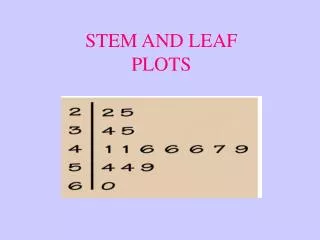
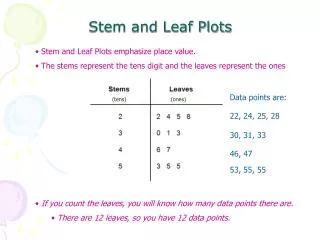
Stem and Leaf Plots • Stem and Leaf Plots emphasize place value. • The stems represent the tens digit and the leaves represent the ones Data points are: (tens) (ones) 22, 24, 25, 28 30, 31, 33 46, 47 53, 55, 55 • If you count the leaves, you will know how many data points there are. • There are 12 leaves, so you have 12 data points.
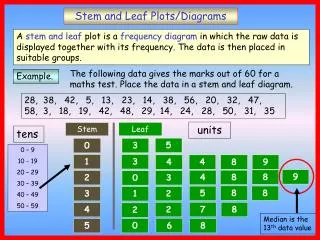
Stem and Leaf Plots • Put the following values into a stem and leaf plot. • 5, 8, 10, 15, 17, 31, 31, 32 (tens) (ones) 0 5 8 1 0 5 7 2 1 1 2 3
Minimum, Maximum, Range minimum point (tens) (ones) Combine the tens and ones 20 + 2 = 22 maximum point Combine the tens and ones 50 + 5 = 55 22 55 33 Minimum = _______ Maximum = _______ Range = _______ (55 – 22)
Median • Cross out the smallest and highest leaves together until you find the middle value. • If there are 2 middle values, take the average of the 2. (tens) (ones) 31 + 33 = 64 64 ÷ 2 = 32 32 Median = _______
Median • If crossing out the leaves confuses you, list the data points out first and then cross them off 22, 24, 25, 28, 30, 31, 33, 46, 47, 53, 55, 55 (tens) (ones) 31 + 33 = 64 64 ÷ 2 = 32 32 Median = _______
Mode • The mode is the value(s) that occurs most often. (tens) (ones) 4 7 Remember: This represents 47 47 Mode = _______ • Don’t get confused. The mode is not 7 or 77!
Stem and Leaf Plots • Sometimes the stem is the ones place and the leaf is the tenths place Data points are: 2.2, 2.4, 2.5, 2.8 3, 3.1, 3.3 4.6, 4.7 5.3, 5.5, 5.5