Understanding pH Scale: The Power of Hydrogen and its Relationship with Molarity
250 likes | 392 Vues
This guide explores the pH scale, a logarithmic scale measuring hydrogen ion concentration [H+1]. A change of one unit in pH results in a tenfold change in [H+1]. The relationships between pH, pOH, and [OH-1] are detailed, emphasizing the neutrality of pure water at pH 7. We also explain how to calculate pH from molarity and vice versa, including the use of scientific notation. Additionally, safe methods for testing pH using pH meters and indicators are discussed to ensure accurate measurements and understanding of acidity and basicity.


Understanding pH Scale: The Power of Hydrogen and its Relationship with Molarity
E N D
Presentation Transcript
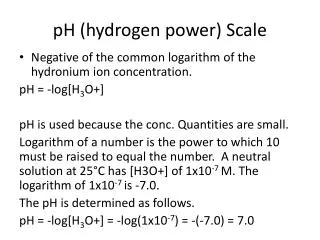
pH scale • Logarithmic scale • expressing H+1 concentration, [H+1] • If pH changes by factor of 1, [H+1] changes by factor of 10 • pH = -log[H+1]
Molarity to pH To determine pH: • express [H+1] in scientific notation • remember, [ ] means concentration of whatever is inside brackets • log is the power of 10
Molarity to pH for Pure water tiny bit of ionization in pure water: H2O H+1 + OH-1 • [H+1] = [OH-1] = 1 X 10⁻⁷M • pH =-log[H+1]= -(-7) = 7
[H+1] 1 M or 1X100 M 0.1 M or 1 X 10⁻¹M 0.01 M or 1 X 10⁻²M .001 M or 1 X 10⁻³M pH 0 1 2 3 pH
pH to Molarity pH = -log[H+1], solve for [H+1] • -pH = log[H+1] • antilog(-pH) = [H+1] • say pH = 5, then –pH = -5 • antilog(-5) = 10-5 • the –pH becomes the power of 10!
pOH • by analogy: pOH is defined as –log[OH-1] • express [OH-1] in scientific notation • if [OH-1] = 1.0 X 10⁻³ M • then pOH = -log(10-3) = -(-3) = 3
pH range • 0 to 14 (7 is neutral) • pH = 0, strongly acidic • pH = 14, strongly basic
ACID or BASE? • acids: [H+1] [OH-1] • bases: [OH-1] [H+1]
Relationships of: pH, pOH, [H+1] and [OH-1] productof [H+1] and [OH-1] is always 1x10⁻¹M add exponents when multiple in scientific notation sum of pH and pOH is always 14
11 4 5 13 pH + pOH = 14 • pH = 3, pOH = • pH = 7, pOH = • pH = 10, pOH = • pH = 9, pOH = • pH = 1, pOH = 7
1 x 10⁻⁴ M 10 1x10⁻¹⁰ M if pH = 4 • [H+1] = ? • pOH = ? • [OH-1] = ?
14 – 3 = 11 1x10-11 M if the [OH-1] = 1 X 10⁻³ pOH = -log[OH-1] = -log(10-3) = -(-3) = 3 • pOH = ? • pH = ? • [H+1] = ?
5 14 – 5 = 9 1x10⁻⁹M if the [H+1] = 1 x 10⁻⁵M • pH = ? • pOH = ? • [OH-] = ?
[H+] (M) pH [OH-] (M) pOH Acidic or Basic 3 1x10⁻³ 1x10-11 11 A 1x10⁻⁵ 5 1x10⁻⁹ 9 B 1x10⁻² A 1x10-12 12 2 6 B 1x10⁻⁶ 8 1x10⁻⁸
How to safely test pH • instruments – use a pH meter • indicators – use a series of indicators • see if substance reacts with a metal other than Cu, Ag, or Au • NEVER “taste”
Indicator • substance that changes color over narrow pH range • use several indicators to narrow down pH range of substance • See Table M