Download
1 / 20
200 likes | 346 Vues
Thrift institutions, including savings associations, savings banks, and credit unions, primarily focus on residential mortgages and consumer loans. Established to meet the financial service needs of retail consumers, these institutions have evolved through historical shifts in regulation and market dynamics. They experienced significant changes post-FIRREA of 1989, affecting how they operate and manage their assets and liabilities. Today, they face challenges such as disintermediation and fluctuating interest rates, impacting their profitability and sustainability.

E N D
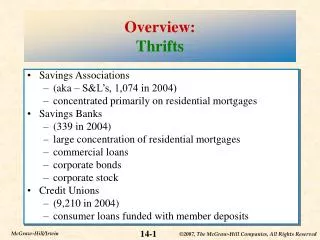
Overview: Thrifts • Savings Associations • (aka – S&L’s, 1,074 in 2004) • concentrated primarily on residential mortgages • Savings Banks • (339 in 2004) • large concentration of residential mortgages • commercial loans • corporate bonds • corporate stock • Credit Unions • (9,210 in 2004) • consumer loans funded with member deposits McGraw-Hill/Irwin
Thrift Institutions • Thrift Institutions originated out of the needs that the retail (consumer) sector had for financial services that commercial banks did not address. • Historically, the primary service has been residential mortgage lending McGraw-Hill/Irwin
Thrift Institutions Residential Mortgages Savings Associations Individuals Deposits Residential Mortgages Individuals Deposits Savings Banks Commercial Loans Corporations Deposits Consumer Loans Credit Unions Individuals Deposits McGraw-Hill/Irwin
Savings Banks • Established as mutual organizations and largely confined to the East Coast and New England states • Deposits are insured by the FDIC under the Bank Insurance Fund (BIF) • Have been allowed greater freedom to diversify into corporate bonds and stocks • Rely more on deposits than savings associations and have fewer borrowed funds McGraw-Hill/Irwin
Real Estate Assets of Savings Associations and Savings Banks McGraw-Hill/Irwin
Definitions • Net interest margin - interest income minus interest expense divided by earning assets • Disintermediation - withdrawal of deposits from depository institutions to be reinvested elsewhere, e.g., money market mutual funds • Regulation Q ceiling - an interest ceiling imposed on small savings and time deposits at banks and thrifts until 1986 (continued) McGraw-Hill/Irwin
Regulator forbearance - a policy of the FSLIC not to close economically insolvent FIs, allowing them to continue in operation • Savings institutions - savings association and savings banks combined • Financial Institutions Reform, Recovery, and Enforcement Act (FIRREA) of 1989 - abolished the FSLIC and created a new savings association insurance fund (SAIF) under the management of the FDIC • QTL test- qualified thrift lender test that sets a floor on the mortgage-related assets that thrifts can hold • Mutual organization - an institution in which the liability holders are also the owners McGraw-Hill/Irwin
Regulators of Savings Institutions • Office of Thrift Supervision - established in 1989 under the FIRREA, charters and examines all federal savings institutions and supervises the holding companies of savings institutions • The FDIC - oversees, manages SAIF and BIF • SAIF - provides insurance coverage for savings associations • BIF - provides insurance coverage for savings banks • Other regulators - state-chartered savings institutions are regulated by state agencies McGraw-Hill/Irwin
Savings Institutions • Primary asset • Long-term residential mortgage loans • Primary liability • Short-term deposits of small savers • How do they make money? • Lend long (residential mortgages) 6% • Borrow short (Savings account deposits) 1.50% McGraw-Hill/Irwin
Borrow short, lend long • In general this strategy worked well from mid 1940’s to the late 1970’s • Characteristically, during this period: • Typically the yield curve was normally sloped • Globalization was much less developed • Interest rates were not very volatile • The economic problems of one country had less impact on the economies of other countries • Borrow short, lend long - broke down in the mid to late 1970’s • Initially, the oil shock (73-74) ignites inflationary concerns • Fed responds by constricting the money supply • Targeted reserves rather than interest rates (Oct 79 – Oct 82) • Result: • Historically high inflation rates • Historically high interest rates • An inverted yield curve McGraw-Hill/Irwin
Borrow short, lend long McGraw-Hill/Irwin
Borrow short, lend long continued • Now savings associations are faced with: • Negative interest margins • Paying 15% on short-term deposits • Receiving 12% on long-term lending • Threat of disintermediation by money market mutual funds • Driven by Regulation Q • Savings associations were regulated in what interest rate they could pay on deposits • Capped at 5.25 to 5.50% McGraw-Hill/Irwin
S & L Crises • Legislation expanded deposit taking and investment powers • Liability side • NOW accounts (interest bearing checking) • MMDA’s (money market deposit accounts) • Asset side • ARM’s (adjustable rate mortgages) • Expanded commercial lending • Expanded consumer real estate development • New powers enticed some to assume undue risk • Mid 1980’s real estate in Texas and Southwest collapses • Later economic downturns in Northeast and Western U.S. • Result - Many savings associations with exposure to these areas defaulted McGraw-Hill/Irwin
S & L Crises • FSLIC practiced “regulator forbearance” which encouraged the assumption of risk • Insurance premiums were not tied to risk profile of the institution • Result: • From 1982 - 1992, 1248 savings associations failed • FSLIC was forced into insolvency • Financial Institutions Reform, Recovery, and Enforcement Act (FIRREA) • FSLIC abolished • Office of Thrift Supervision created • Resolution Trust Corp (RTC) created • Charged with closing and liquidating insolvent institutions McGraw-Hill/Irwin
Current status of Savings Associations • Viability of savings associations is challenged • Mortgage lending is a very competitive • GSE’s • Securitization • Commercial banks • Other financial institutions • Long-term mortgage lending has risks • Credit • Interest rate • Liquidity • Transition from mutual to stock organizations • Mutual - Less risky - Less access to capital • Stock - Higher required returns - Greater access to capital McGraw-Hill/Irwin
Credit Unions • Are not-for-profit depository institutions mutually organized and owned by their members (depositors) • CU member deposits (shares) used to provide loans to other members with earnings from these loans used to pay interest on member deposits • Tend to hold higher levels of equity than other depository institutions • Can be federally chartered and regulated by NCUA or state chartered and regulated by the state • Growth is not the primary goal McGraw-Hill/Irwin
Credit Unions • Not for profit depository institutions. Originated as mutual organizations throughout the U.S. (initially the NorthEast) as “self-help” organizations. • Objective – use common resources to alleviate poverty • Tax exempt status • Defined “common bond” of members • Members pay an entrance fee, make their deposits and those monies are lent to other members • Three tiers • U.S. Central Credit Union • Corporate Credit Unions • Credit Unions • Federally chartered credit unions subject to regulation by NCUA McGraw-Hill/Irwin
Composition of Credit Union Loan Portfolio, 2004 McGraw-Hill/Irwin
Composition of Credit Union Investment Portfolio, 2004 McGraw-Hill/Irwin
Composition of Credit Union Deposits, 2004 McGraw-Hill/Irwin