Way Forward
110 likes | 225 Vues
This document outlines a comprehensive strategy for enhancing taxonomic research and biodiversity monitoring across Eastern Africa. It emphasizes the need for collaboration, addressing technical and funding challenges, and prioritizing projects related to agricultural pests, wildlife conservation, and microbial diversity. The text highlights existing strengths such as regional expertise networks and proposes targeted initiatives for taxonomic training and inventory management, including projects on indigenous livestock, fish fauna of Lake Victoria, and essential pollinator species.


Way Forward
E N D
Presentation Transcript
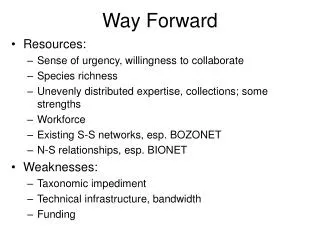
Way Forward • Resources: • Sense of urgency, willingness to collaborate • Species richness • Unevenly distributed expertise, collections; some strengths • Workforce • Existing S-S networks, esp. BOZONET • N-S relationships, esp. BIONET • Weaknesses: • Taxonomic impediment • Technical infrastructure, bandwidth • Funding
Elements of a Barcoding Project CBOL and Member Orgs Development Agencies BOLD Training USERS, Policy-Makers Taxonomists and Curators Technical facilities
Major Points of Agreement • Technical training is needed, in appropriate form
Potential Priority Projects • Agricultural pests • Wildlife • Indigenous livestock vs. introduced species (existing ILRI project) • Lake Victoria fish fauna (native and introduced) – Ichthyology – NMK • Dryland plants – seedbanks, existing collections • Coastal forests, eastern arc • African grasses ID system, cereals • Birdlife International, Nature Kenya, Nature Uganda, Tanzania – birds in conservation regions
Potential Priority Projects • Aviation birdstrike, potential source of specimens • Trade of wildlife/plant products (esp. bushmeat), monitoring movement, forensic evidence of region of origin, link to CITES, CBD, CMS (law enforcement users) • Microbial diversity (industrial/medical enzymes) • Mycotoxin producers, food contaminants (health/standards/food users)
Potential Priority Projects • Migratory birds, avian flu • Emerging infectious diseases (e.g., schistosomyosis) • Rank by health, environment, economic importance • Marine protected areas (KWS managed); inventory for species management • Inventory of KWS parks
Conservation (1) • Makerere Univ, NMK, Dar Es Salaam Univ., KWS, enforcement agencies, Field Museum, Tanzania Wildlife Research Inst • Trade of wildlife/plant products (esp. bushmeat), monitoring movement, forensic evidence of region of origin, link to CITES, CBD, CMS (law enforcement users) • Univ. Dar Es Salaam (taxonomy, collections), NMK, Birdlife International, Nature Kenya, Nature Uganda, Tanzania, Ethiopia – birds in conservation regions • Univ Dar Es Salaam, Zanzibar • Lake Victoria fish fauna (native and introduced) – Ichthyology – NMK – impact on 3 countries; fits with ongoing project
Conservation (2) • Univ. Addis Ababa, NMK, RBG Kew, Univ. Dar Es Salaam (RPSUD), National Gene Banks of Ethiopia and Kenya • Dryland plants – seedbanks, existing collections • Univ. Addis Ababa, NMK, RBG Kew, Univ. Dar Es Salaam • African grasses ID system, cereals • African Pollinators Initiative (BioNET LOOPs) • Pollinators – strong international taxonomic community (GBIF proto-campaign under seed grant program, with FAO; constructing global taxon list and 1M specimen records online; GEF proposal being resubmitted) • NGISA/COML, western Indian Ocean, KWS (see Amsterdam meeting report) • Marine protected areas (KWS managed); inventory for species management • Inventory of KWS parks • Coastal forests, eastern arc
Environment • Ethiopian Inst. Agric. Research; KWS, • Invasive species (plants, freshwater species), marine ballast water
Economic • KENYA SOCIETY FOR MICROBIOLOGY; Univ. Dar Es Salaam Department of Molecular Biology, Faculty of Microbiology; Inst. Biodiversity & Conservation; Addis Ababa Univ. • Mycotoxin producers, food contaminants (health/standards/food users) • Microbial diversity (industrial/medical enzymes), industrial interest, biomining (NCST, CABI); need BRCs, protection of genetic stocks • Fungi as potential food source, ID for edible species • NMK Dept. of Ichthyology and FISH-BOL • Lake Victoria fish fauna (native and introduced) – Ichthyology – NMK – impact on 3 countries, fishing industry • NMK Ornithology and ABBI • Aviation birdstrike, potential source of specimens; aviation safety (fits with avian flu priority) • ICIPE, agricultural research inst’s in 4 countries; • Indigenous livestock vs. introduced species (existing ILRI project); has training platform, (DNA fingerprinting or barcoding?) • Agricultural pests, livestock diseases • African grasses ID system, cereals • Pollinators – strong international taxonomic community
Health • NMK, KWS, KMRI, Dept. Veterinary Services • Migratory birds, avian flu • Epizootic diseases • Emerging infectious diseases (e.g., schistosomiasis) with CDC, WHO (freshwater snails, NMK, Denmark institute) • Mycotoxin producers, food contaminants (health/standards/food users)