Understanding Gravitational Forces in the Milky Way and Beyond
This content explores gravitational forces and the structure of the Milky Way galaxy, including its relationship to neighboring galaxies in the Local Group and Local Supercluster. It delves into key concepts from Newton's law of gravitation to Einstein's theory of relativity, discussing the principles of universal gravitation, gravitational potential energy, tidal forces, and the characteristics of black holes. The material also covers Kepler's laws of planetary motion and the behavior of celestial bodies under gravitational influence, making complex astrophysics accessible to all.

Understanding Gravitational Forces in the Milky Way and Beyond
E N D
Presentation Transcript
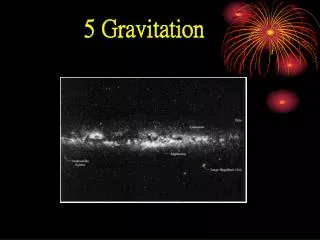
5-1 The world and the gravitational force • The Local Supercluster • The Local Group The Milky Way and the Andromeda galaxy Cluster: Hydra and Centaurus
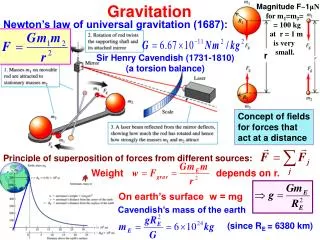
5-2 Newton's law of gravitation Newton (23) —1665
Three reasons that 1. Earth is not uniform. 2. Earth is not a sphere. 3. Earth is rotating.
例 5-3 A pulsar 例 5-4 The difference in ag (a) In the vicinity of Earth
5-5 Gravitation inside Earth A uniform shell of matter exerts no net gravitational force on a particle inside it. 例 5-5 Express delivery
Potential energy and force Escape velocity
5-7 Planets and Satellites: Kepler’s Laws 1. The law of orbits. elliptical orbitseccentricitysemimajor(semiminor) axis
例 5-7 Finding the mass: 例 5-8 Comet Halley
14-8 Satellites: Orbits and Energy The potential energy The kinetic energy
5-9 Einstein and Gravitation • General/special theory of relativity • Principle of equivalence: gravitation and acceleration are equivalent.
Curvature of Space Gravitation is due to a curvature of spacetime that is caused by the masses.