Download
1 / 12
120 likes | 225 Vues
This study explores the use of Web 2.0 technologies, specifically Google Wave and Google Apps, to foster interdisciplinary collaboration among students at Universitat Oberta de Catalunya. By creating a virtual platform equipped with various collaborative tools, this approach not only aims to solve complex problems through teamwork and critical thinking but also enhances professional development. Results show that most participants valued this structure, demonstrating the need for such experiences in graduate training. The study addresses barriers and success factors critical for implementing effective collaborative learning environments.

E N D
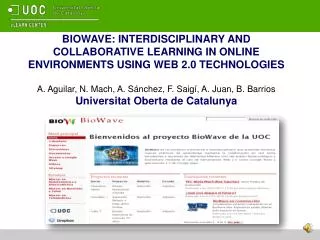
BIOWAVE: INTERDISCIPLINARY AND COLLABORATIVE LEARNING IN ONLINE ENVIRONMENTS USING WEB 2.0 TECHNOLOGIES A. Aguilar, N. Mach, A. Sánchez, F. Saigí, A. Juan, B. Barrios UniversitatOberta de Catalunya
Introduction • To solve complex problems it’s necessary: • Expertise • Interdisciplinary approach • Teamwork • Critical Thinking • Participation • Web 2.0 tools are • Widely available and accessible • Low cost • Versatile
Hypothesis • Can Web 2.0 tools, like Google Wave and Google Apps, encourage interdisciplinary collaboration between different studies at the Universitat Oberta de Catalunya?
Methodology • Virtual platformbasedon Google Sites • Google wave • Google appstools • Documentrepository • Videos • PBL focusedonNutrigenomics • Qualitative-quantitativemethodologytostudyperceptions and opinionswithanonymoussurvey
Qualitative results • The majority of the respondents agreed that was a very between students from interesting system of interaction different disciplines and useful for their future professional development. • The majority of the participants also expressed their interest that such experiences are routinely included in their graduate training programs. • Initially uncomfortable with the control of the Google Wave tool • Reluctant to participate in extra-curricular activities • Allusions to a lack of time
Quantitativeresults • 71,4% of participants had consulted the various links on the site Biowave. • 78,6% of the participants had accessed intensively or frequently the main tool: Google Wave. • 92,9%of participants have had to consult the documentation available on the use of Biowave. • Approximately 35% of the students have viewed the videos
Quantitative results • Useful for interaction and for professional careers • Useful to encourage interaction and e-collaborative work
Quantitative results • 64.3% of participants value the need to encourage this type of experience in the online learning environments • 57.1% of the respondents considered the regular introduction (generalized) of this type of experience in the formative training as very convenient or enough convenient.
Discussion and conclusions • Biowave Platform allowed: • To exchange information and to share knowledge from a holistic approach of reality • To be aware how the interdisciplinary approach can help solving complex problems • To overcome limitations of working in a specific area • To encourage interaction • Positive evaluation of the interaction and collaboration • Useful for their future careers • Recommendedfor inclusion in formative training
Discussion and conclusions • Barriers • Overcome the reluctance expressed to participate in extra-curricular activities • Perception as an extra work • Overcome the reluctance to use unfamiliar tools • Difficulty to adapt schedules and time • Success factors • Instructor’s role • To solve problems that participants can recognize and perceive as useful and belonging to their main field
Discussion and conclusions • Improvementproposals • To incorporate proposals that enable a joint design and an appropriate structuring and timing. • To add strategically in the training programs communication skills and online collaboration tools, • Larger period of time
aaguilarmart@uoc.edu Thankyou!