Exploring the Art of Satire: Techniques and Examples
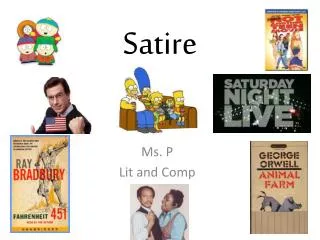
Delve into the world of satire, where irony, sarcasm, and parody expose societal vices and follies. This insightful overview examines key techniques such as hyperbole, juxtaposition, and double entendre. By defining each concept and providing illustrative examples, we highlight how these literary devices create humor and provoke thought. Discover how wit and clever observation illuminate human nature and critique the norms of society. Engage with the rich tradition of satirical writing and its enduring relevance in contemporary discourse.

Exploring the Art of Satire: Techniques and Examples
E N D
Presentation Transcript
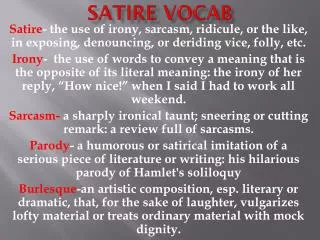
Satire Vocab Satire- the use of irony, sarcasm, ridicule, or the like, in exposing, denouncing, or deriding vice, folly, etc. Irony- the use of words to convey a meaning that is the opposite of its literal meaning: the irony of her reply, “How nice!” when I said I had to work all weekend. Sarcasm- a sharply ironical taunt; sneering or cutting remark: a review full of sarcasms. Parody- a humorous or satirical imitation of a serious piece of literature or writing: his hilarious parody of Hamlet's soliloquy Burlesque-an artistic composition, esp. literary or dramatic, that, for the sake of laughter, vulgarizes lofty material or treats ordinary material with mock dignity.
Hyperbole- obvious and intentional exaggeration. Juxtaposition- an act or instance of placing close together or side by side, esp. for comparison or contrast. Analogy- a similarity between like features of two things, on which a comparison may be based: the analogy between the heart and a pump. Double Entendre- a word or expression used in a given context so that it can be understood in two ways, esp. when one meaning is risqué Wit- powers of intelligent observation, keen perception, ingenious contrivance, or the like; mental acuity, composure, and resourcefulness: using one's wits to get ahead.