Understanding Precipitation: A Hands-On Rain Gauge Activity from NASA's GPM Mission
140 likes | 257 Vues
Explore the importance of measuring rain and snow with this engaging rain gauge activity developed by NASA's GPM Education and Public Outreach Team. Dive into key topics, such as the Earth's water cycle, the difference between freshwater and saltwater, and how precipitation occurs globally. Collaborate with a partner to design and create your own rain gauge. Analyze collected data to understand how scientists measure rainfall worldwide. This activity enhances understanding of vital water resources and highlights the significance of accurate precipitation measurement.


Understanding Precipitation: A Hands-On Rain Gauge Activity from NASA's GPM Mission
E N D
Presentation Transcript
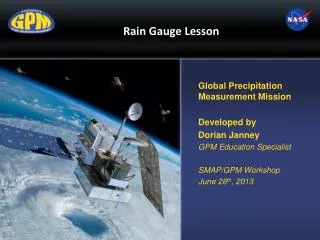
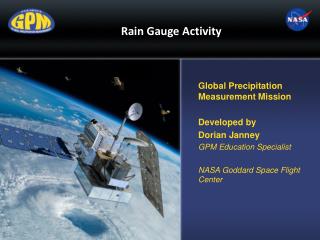
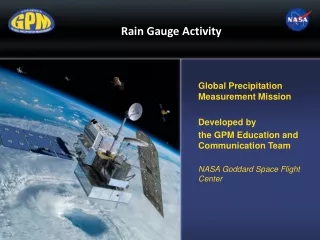
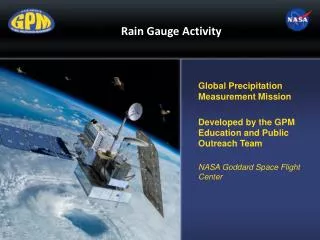
Global Precipitation Measurement Mission Developed by the GPM Education and Public Outreach Team NASA Goddard Space Flight Center Rain Gauge Activity
Guiding Questions The Big Picture: Why is it important to measure rain and snow around the globe? Earth’s Water: How much of Earth’s water is freshwater? Freshwater versus Saltwater: Which of these do we need for our survival? The Water Cycle: How does water move through the “water cycle? Precipitation: Where do rain and snow come from? Are these made up of freshwater or saltwater? Making a Rain Gauge to Measure Rain: Can we make a rain gauge that we can use to measure rain in our area? GPM: How will the GPM mission measure precipitation all over the world?
Earth’s Water Activity 1. Fill plastic cup 70% full of water. Amount of water on Earth’s surface. Take out one dropper of water, and place it in small cup. Amount of freshwater on Earth. Take one drop of water from small cup. Amount of accessible freshwater.
Earth’s Water Cycle “The Water Cycle: animation from NASA/GSFC SVS # 10501
The Big Picture The Freshwater Connection Link to GPM movie
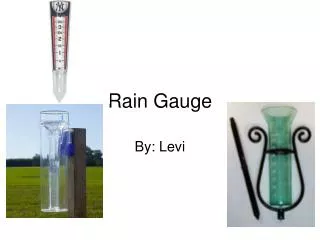
Measuring Rain • Let’s make rain gauges. These are used to measure how much it rains in a specific place. • Work with a partner, and use the materials on the table to try to make something that you could use to measure how much rains falls in one day.
Design Considerations • What did you find difficult about this task? • Which design do you think would be the most effective for measuring precipitation? • Why? • What are some design factors that you think are important to have consistent for the rain gauges? • Why? • What could you do to improve your rain gauge?
“For Good Measure” http://pmm.nasa.gov/education/videos/for-good-measure
Extra Slides - If you have time to go outside and simulate rain and have students collect data, you can use the next slide to have them share in data and compare it.
Discussion • What did we notice about our data? • What might we change next time to collect more accurate data? • How do you think scientists collect data on how much rain falls around the world?