Math problem-solving tips and examples | Test your math skills
Learn helpful math-solving strategies and practice with various equations and numbers. Test your skills with examples and explanations provided. Improve your math knowledge and problem-solving abilities.

Math problem-solving tips and examples | Test your math skills
E N D
Presentation Transcript
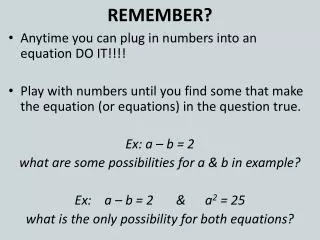
REMEMBER? • Anytime you can plug in numbers into an equation DO IT!!!! • Play with numbers until you find some that make the equation (or equations) in the question true. Ex: a – b = 2 what are some possibilities for a & b in example? Ex: a – b = 2 & a2= 25 what is the only possibility for both equations?
A.y • B.2y • C.y2 • D.2y2 • E.4y2
Explanation a2+2ab+b2= (a+b) x (a+b) = (a+b)2 = y2
If |a| < |b|, and a > b, which of the following is necessarily true? • A. |a + b| > |b| + |a| • B. |a + b| < a – b • C. |a| + |b| > 2|b| • D. |a - b| > a + b • E. |a| - |b| > |a - b|
Explanation Because the absolute value of a is less than that of b, a is a lesser magnitude than b. However, a > b, so a must be a positive number and b a negative number. So, you can plug in numbers: a = some positive number of magnitude less than b, which is negative Example: a = 3, b = -10. Plug them in, and only B works out.
How many numbers less than 1000 are divisible by 3? • A.300 • B.310 • C.311 • D.333 • E. 500
The Quotient = the # of multiples of the divisor 4/2 = 2 (quotient) 2 x 1 & 2 x 2 = #’s less than 4 that are divisible by 2 (1) (2) = 2 (multiples) 2 = 2 Quotient = multiples
Let’s try another Ex: 9 / 3 = 3 3 x 1 3 x 2 3 x 3
So… If you divide a number by a multiple the product is equal to the number of multiples which go into the number, so divide 1000 by 3 and take the whole part 1000 ÷ 3 = 333.3333 Rounded = 333
REMEMBER? • What is a polygon? • Think about the prefix “poly” • How many sides do the following figures have? • Square • Triangle • Octogon • Pentagon • Line Which of the above is not a polygon?
A regular polygon has 9 sides. What is the degree measure of the angle, within the polygon, between any two sides? • A.60 • B.90 • C.120 • D.140 • E. 165
Explanation First, you must figure the sum of the measures of the internal angles, which is equal to (n-2)180 So…. (9-2)180 = 7 * 180. Then, you should divide this measure by the number of sides to find the length of each angle. So… (7 * 180)/9 = 7 * (180/9) = 7 * 20 = 140 degrees
Remember? First we need to review factorials. Factorials are the product of all positive integers less than or equal to n (a given number). We use this concept most commonly as a way to arrange n distinct objects into a sequence This is written simply as n! Ex: 5! = 5 x 4 x 3 x 2 x 1
How many ways can Pete, Mary, Joe stand in a line if Joe and Marycannot stand next to each other? • A.1 • B.2 • C.3 • D.4 • E.6
Explanation Pete, Mary, and Joe are 3 people, so the number of possible orders will be 3! 3! = 3 x 2 x 1 = 6 #of possible orders (minus) # of not possible orders Not possible orders = The # of ways that M & J will stand together: (MJS, MSJ, SJM, JSM) = 4 So, 6-4 = 2 ways.
How many ways can Pete, Mary, Sue, and Joe stand in a line if Joe and Sue cannot stand next to each other? • A.4 • B.6 • C.12 • D.16 • E. 18
Explanation Number of ways = Total number of ways that PMSJ can stand together - Number of ways that SJ stand next to each otherThe total number of ways that PMSJ can stand next to each other is equal to 4! = 4*3*2*1 = 24.The number of ways that SJ will end up standing next to each other is 6: (SJPM, PSJM, PMSJ, JSPM, PJSM, PMJS)So, 24 - 6 = 18 ways.
A square, X, has sides of length n. Another square, Y, has sides of length 1.5n. How many X can fit into a single Y? • A.1 • B.1.5 • C.2 • D.2.25 • E. 4
Explanation The number of X's that fit into Y is equal to the ratio of area of Y to that of X. *Remember area or a square = length times width Area of Y = (1.5n)2= 2.25 Area of X = n2 So… 2.25n2/n2= 2.25
A cubic box, X, has sides of length n. Another cubic box, Y, has sides of length 2n. How many boxes X could fit into a single box Y? • A.2 • B.4 • C.8 • D.16 • E. 32
Explanation The volume of Y is equal to (2n)3= 8n3. The volume of X is equal to n3. So, to find the number of X's that could fit into Y, Y ÷ X or 8n3/n3 8
A triangle has sides of length 7, 11, and X. Which of the following cannot be X? • A.2 • B.4 • C.8 • D.12 • E. 18
Explanation The sum of lengths of two sides of a triangle cannot be less than the length of the third side. So… 2 + 7 = 9, but 9 < 11
A number is called "round" if it contains at least one zero as a digit. How many three-digit numbers are "round?" • A.153 • B.171 • C.178 • D.179 • E. 215
Explanation An easy strategy here is to just count the number of "round" numbers between 100 and 199 and multiply that number by 9 for every hundreds digit (100, 200, 300... to 900). There are 19 "round" numbers through 100-199 (100, 101, 102 ... 109 = 10 + and 110, 120, 130... 190 = 9). 19 * 9 = 171
If a two-sided coin is flipped three times, what is the probability that at least one head will show up? • A.1/8 • B.3/8 • C.1/2 • D.2/3 • E. 7/8
Explanation The probability of one head showing up is equal to 1 - P(All tails), and the probability of all tails is (1/2)3= 1/8, so 1- (1/8) = 7/8