Download
1 / 11
110 likes | 245 Vues
This chapter emphasizes the importance of teaching children how to think critically by modeling reasoning skills and encouraging curiosity. Children absorb attitudes from significant adults, making it essential to foster an environment that values independent reasoning. Strategies to promote critical thinking include questioning beliefs, accepting diverse viewpoints, and applying Bloom's Taxonomy to guide learning. By engaging children in provocative inquiry and nurturing skills like logic, reasoning, and analysis, we can cultivate thoughtful, independent thinkers equipped for life's challenges.

E N D
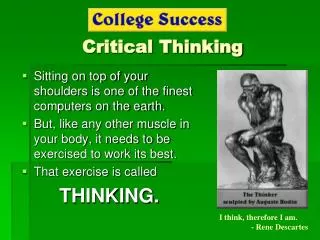
Children need to be shown HOW TO THINK CRITICALLY adult = model children absorb the attitudes and opinions of the significant adults in their lives
It is important to encourage children to VALUE THE AUTHORITY OF THEIR OWN REASONING CAPACITIES • to question their own reasoning and the reasoning of others • to accept points of view and beliefs different from their own to reach a balanced judgement
CRITICAL THINKER readiness willingness passion to reason to challenge for truth healthy be open minded attitude of attitude to and self-critical doubt, search arguement for truth
THE SKILLS OF CRITICAL THINKING Evaluation Synthesis Analysis Application Comprehension Knowledge H. Bloom’s Taxonomy of educational goals
guide children in learning how to learn & how to think for themselves through TEACHING STRATEGIES todevelop reasoning skills (teach critical thinking through teachers applying the strategies of CT in their own lesson planning) in every-day activity
CRITICAL THINKING FOR RICHARD PAUL identifies the uncritical the selfish the reasonable thinker thinker thinker
CT strategies Affective strategies foster intellectual independence + encourage self-questioning Macro abilities develop global thinking abilities • Giving reasons • Identifying purposes • Evaluating outcomes • Identifying criteria • Making judgements
Child = curiosity foster curiosity respond to through provocative questions with and open-ended the child questions “How can WE find this out?” consider the importance of encourage logic- THINKING TIMEdeductive reasoning (encourage child to do his (develop skills of defining, own thinking) ordering, classifying, sequencing and abstraction)
!deductive reasoning = creative thinking ability to consider all the possible factors in problem solving understand the seek evidences and meaning of words fit the elements into (related to context, a logical chain of shared assumptions reasoning personal associations) (patterning of experience)
REASONING Sequencing Classifying Judging Predicting Theorising Understanding others and oneself COMMUNITY OF ENQUIRY