Mechanical Properties of Lattice Structures: Insights from Strut Geometry to Material Composition
This study explores the mechanical properties of various lattice structures, focusing on how geometry and material composition affect their strength and buckling behavior. It examines solid vs. hollow struts, the impact of grain size and dislocation density on material strength, and the compressive responses of different strut geometries under axial and inclined loads. Key findings reveal that wall thickness and topology significantly influence mechanical performance, demonstrating the efficiency of lattice materials for structural applications. Relevant literature is referenced for further insights.

Mechanical Properties of Lattice Structures: Insights from Strut Geometry to Material Composition
E N D
Presentation Transcript
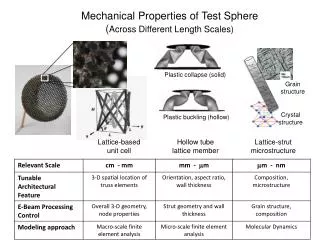
Mechanical Properties of Test Sphere (Across Different Length Scales) Plastic collapse (solid) Grain structure Crystal structure Plastic buckling (hollow) Lattice-based unit cell Hollow tube lattice member Lattice-strut microstructure
Properties of the Strut • Critical Features • Composition • Microstructure • Grain size • Dislocation density/distribution • Geometry/Topology Grain size effect on strength ORNL Sphere (e-beam processed) Dislocation effect on strength
Compressive Response for Different Strut Geometries Loaded Axially a • Mechanical behavior of struts depends on: • Material properties – strength, modulus… • Geometry – solid or tube will change buckling behavior • Tube – wall thickness will control buckling b c d e Pingle S M et al. Proc. R. Soc. A doi:10.1098/rspa.2010.0329
Compressive Response for Different Strut Geometries Loaded at an Incline a • Mechanical behavior of struts load on an incline: • Buckling will depend on load path • Mechanical properties of nodes where struts connect are critical • Tube – wall thickness will control buckling b c d e Pingle S M et al. Proc. R. Soc. A doi:10.1098/rspa.2010.0329
Properties at the Lattice Scale Compressive Strength vs. Density of Lattice Materials Pyramidal hollow lattice truss of single crystal SS Structural efficiency of hollow stainless steel trusses under compression >4X sY=180MPa Lattice materials allow for more efficient structural loading under compression Pingle S M et al. Proc. R. Soc. A doi:10.1098/rspa.2010.0329