Download
1 / 15
150 likes | 254 Vues
Explore the intricate workings of the cardiac cycle, from muscle contractions to electrical impulses. Learn about the heart's control mechanisms and how abnormalities can lead to serious conditions like fibrillation. Watch informative videos and grasp the importance of ECGs in monitoring heart health.

E N D
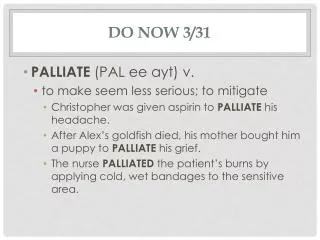
Do Now 3/31 • PALLIATE (PAL eeayt) v. • to make seem less serious; to mitigate • Christopher was given aspirin to PALLIATE his headache. • After Alex’s goldfish died, his mother bought him a puppy to PALLIATE his grief. • The nurse PALLIATED the patient’s burns by applying cold, wet bandages to the sensitive area.
The mammalian heart Ch 9
Heart • Made of cardiac muscle filled with blood • Coronary arteries deliver blood to the walls of the heart itself
The cardiac cycle • Heart beats ~70x/min in continuous cycle • ‘Begin’ with heart filled with blood and muscles in atrial walls contract: called atrial systole • Not very high in pressure b/c walls of atria are thin • Forces blood through atrioventricular valves into ventricles
The cardiac cycle • ~0.1 second after atrial systole is ventricular systole • Generates great pressure (~120mmHg) • Pushed blood through semilunar valves • Last for ~0.3 seconds
The cardiac cycle • When ventricles relax it is called ventricular diastole • As muscle relaxes, pressure in ventricles drops • Semilunar valves prevent backflow http://www.youtube.com/watch?v=jLTdgrhpDCg
Cardiac cycle • Ventricle walls much thicker than atria walls • Generates higher blood pressure in ventricles than atria • Left ventricle thicker than right
Control of the heart beat • Cardiac muscle is myogenic, meaning it naturally contracts and relaxes without nerve impulses • However, individual cells do not (and cannot) contract on their own individual rhythm, it needs to be cyclical with all other heart cells
Control of the cardiac cycle • The heart has its own built-in controlling and coordinating system to regulate cardiac muscle contractions • Cardiac cycle begins specialized patch of al muscle in the right atrium called the sinoatrial node (SAN) aka pacemaker
Control of the cardiac cycle • Muscle cells of the SAN set rhythm for all other heart cells • Their natural rhythm is slightly faster than all other muscle cells • They set up a wave of electrical activity which spreads rapidly over the walls of the atria • Cardiac muscle responds to this electrical excitation by contracting
Control of the cardiac cycle • Band of fibers between atria and ventricles prevent electrical signal from exciting ventricles to contract at the same time and atria • Electric signal must then be passed through conducting fibers in the septum, known as the atrioventricular node (AVN)
Control of the cardiac cycle • The AVN picks up the electrical wave as it spreads out across the atria and passes it on to a bunch of conducting fibers known as the Purkyne tissues (Purkinjie fibers) • Transmits excitation to base of septum where it spreads upwards through ventricle walls, causing ventricles to contract from the bottom up
Improper cardiac coordination • If ventricles fail to contract from bottom up, the coordination of the contraction can go wrong and cause chaotic excitation • Small sections of cardiac muscle contract while other relax, resulting in fibrillation, in which the heart wall simply flutters instead of contracting as a whole • Almost always fatal unless treated instantly • http://www.youtube.com/watch?v=UAs6SDI7HZw
Electrocardiograms (ECGS) • Relatively easy to detect and record waves of excitation flowing through the heart muscle • Electrodes are placed on the skin over opposite sides of the heart • Result is a graph of voltage over time • P= wave of excitation over atrial waves • Q, R, S = wave of excitation over ventricle walls • T = recovery of ventricle walls