Understanding Electricity: Charge, Current, and Voltage Explained
This article covers the fundamental concepts of electricity, focusing on charge, current, and voltage. It introduces the basic particles of atoms including protons, electrons, and neutrons, describing their respective charges. Insights into the nature of electric charge, the units of measurement (Coulombs for charge and Amperes for current), and the difference between conductors and insulators are provided. The article further explains voltage as the energy per charge in a circuit, along with comparisons to water flow to clarify these concepts.

Understanding Electricity: Charge, Current, and Voltage Explained
E N D
Presentation Transcript
Electricity Charge, Current & Voltage
Atoms… • Have neutrons, protons, and electrons. • Protons are positively(+) charged • Electrons are negatively(-) charged • Neutrons have no charge
Charge • Charge is a property of an object, like mass or color or shape. • The unit for charge is the Coulomb (C). The symbol for charge is Q.
The world is filled with electrical charges: + - + + + - + - - + + + - - - + + - - -
Opposites Attract • Positive charges, such as protons, are attracted to negative charges, such as electrons (opposites attract) • Like charges repel (positive charges repel other positive charges, and negative charges repel other negative charges)
Current • Current - the flow of charge through an area in a given time. • The symbol for current is I and the unit is Ampere (A). • I = Q/t (current = charge/time)
Conductors vs. Insulators • Conductors – material through which electric current flows easily. • Insulators – materials through which electric current cannot move.
Conductors: Metal Water Insulators: Styrofoam Rubber Plastic Paper Examples
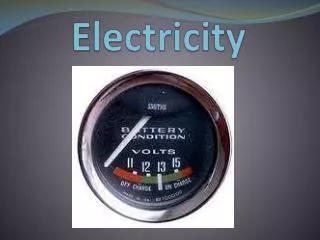
What is Voltage? • The measure of energy given to the charge flowing in a circuit. • The greater the voltage, the greater the force or “pressure”that drives the charge through the circuit.
Potential Difference = Voltage • Potential Difference measures stored electrical energy. • A battery stores electrical and chemical energy. • We define the positive side of the battery to have a positive voltage and the negative side to have 0 voltage. For a 6 Volt battery, the voltage at the positive end is +6 V and at the negative end it is 0 V.
Volts vs. Amps • Example: If electricity was water… • Amps measure how much water comes out of a hose. • Volts measure how hard the water comes out of a hose.