Download
1 / 11
110 likes | 235 Vues
This study focuses on the improvements made to the binary cascade interface within the framework of the FTF (Fritiof) model, aimed at optimizing particle collision dynamics. Key enhancements include the calculation of minimal formation times and synchronization between FTF and Binary Cascade models, leading to more accurate predictions of secondary particle production in nuclear interactions. The findings highlight significant discrepancies in particle multiplicities and energy distributions, suggesting new avenues for tuning the models against experimental data for better alignment with observed results.

E N D
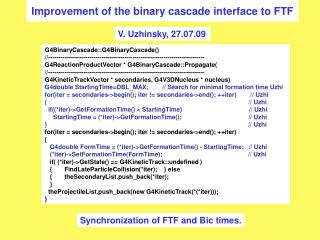
Improvement of the binary cascade interface to FTF V. Uzhinsky, 27.07.09 G4BinaryCascade::G4BinaryCascade() //---------------------------------------------------------------------------- G4ReactionProductVector * G4BinaryCascade::Propagate( //---------------------------------------------------------------------------- G4KineticTrackVector * secondaries, G4V3DNucleus * nucleus) G4double StartingTime=DBL_MAX; // Search for minimal formation time Uzhi for(iter = secondaries->begin(); iter != secondaries->end(); ++iter) // Uzhi { // Uzhi if((*iter)->GetFormationTime() < StartingTime) // Uzhi StartingTime = (*iter)->GetFormationTime(); // Uzhi } // Uzhi for(iter = secondaries->begin(); iter != secondaries->end(); ++iter) { G4double FormTime = (*iter)->GetFormationTime() - StartingTime; // Uzhi (*iter)->SetFormationTime(FormTime); // Uzhi if( (*iter)->GetState() == G4KineticTrack::undefined ) { FindLateParticleCollision(*iter); } else { theSecondaryList.push_back(*iter); } theProjectileList.push_back(new G4KineticTrack(*(*iter))); } Synchronization of FTF and Bic times.
Improvement of the binary cascade interface to FTF G4bool G4BinaryCascade::ApplyCollision(G4CollisionInitialState * collision) //---------------------------------------------------------------------------- G4KineticTrack * primary = collision->GetPrimary(); G4KineticTrackVector target_collection=collision->GetTargetCollection(); G4bool haveTarget=target_collection.size()>0; // for primary resonances, subtract neutron ( = proton) field ( ie. add std::abs(field)) G4int PDGcode=std::abs(primary->GetDefinition()->GetPDGEncoding()); mom4Primary=primary->Get4Momentum(); initial_Efermi=RKprop->GetField(primary->GetDefinition()->GetPDGEncoding(),primary->GetPosition()); if(!haveTarget) // Uzhi { // Uzhi if ( PDGcode > 1000 ) { // Uzhi initial_Efermi = RKprop->GetField(G4Neutron::Neutron()->GetPDGEncoding(), // Uzhi primary->GetPosition()); // Uzhi primary->Update4Momentum(mom4Primary.e() - initial_Efermi); // Uzhi } } else // Uzhi { // Uzhi if ( PDGcode > 1000 && PDGcode != 2112 && PDGcode != 2212 ) { initial_Efermi = RKprop->GetField(G4Neutron::Neutron()->GetPDGEncoding(), primary->GetPosition()); primary->Update4Momentum(mom4Primary.e() - initial_Efermi); } } // Uzhi Putting FTF particles in the potential well.
Improvement of the binary cascade interface to FTF if ( theCapturedList.size() == 1 ) // Uzhi { // Uzhi i=theCapturedList.begin(); // Uzhi G4ReactionProduct * aNew = new G4ReactionProduct((*i)- >GetDefinition()); // Uzhi aNew->SetTotalEnergy((*i)->GetDefinition()->GetPDGMass()); // Uzhi aNew->SetMomentum(G4ThreeVector(0));// see boost below.. // Uzhi precompoundProducts->push_back(aNew); // Uzhi } // Uzhi Transferring of the captured particles into produced ones.
Improvement of the binary cascade interface to FTF FTF + Binary cascade p+Fe 10,000 events per Plab Plab Kin./Tot.energy Number of violeted MaxDeviation (MeV) 2 1.270880e+03 0 4 3.170299e+03 3 3.377268e-02 6 5.134648e+03 1 1.080265e-02 8 7.116562e+03 0 10 9.105649e+03 1 3.237562e-02 12 1.109835e+04 1 1.140682e-02 14 1.309313e+04 0 16 1.508922e+04 1 2.517834e-01 18 1.708617e+04 0 20 1.908372e+04 0 FTF + Binary cascade Pi- Fe 2 2.004864e+03 2 1.855239e+02 4 4.002434e+03 4 4.646540e-02 6 6.001623e+03 6 5.577090e+02 8 8.001217e+03 1 4.412120e-03 10 1.000097e+04 5 1.054503e-01 12 1.200081e+04 9 2.518046e-02 14 1.400070e+04 5 1.288119e-02 16 1.600061e+04 3 2.747157e-02 18 1.800054e+04 7 6.015416e-02 20 2.000049e+04 8 5.448328e+02 Energy conservation.
Where is the Truth? Pi+Xe, Plab <= 8 GeV/c Pprot>220 Mev/c, 20% of protons Must go to pions! 50% of Pi0 are not registered! Proton multiplicity distribution is wrong!
Conclusion The Bertini model predicts too many nucleons! Improved FTF and the binary cascade give promising results for energy fractions. Butthey produce too many Pi0! Proton multiplicitydistributions are wrong. It would be well to tune Bert, BIC and FTF to experimental data at Plab > 1 GeV/c As a temporal solution a Reggeon theory inspiredmodel of nuclear destruction can be installedfor FTF and QGS.
Reggeon theory inspired model of nuclear destruction Model of nuclear disintegration in high-energy nucleus nucleus interactions. K. Abdel-Waged, V.V. Uzhinsky Phys.Atom.Nucl.60:828-840,1997, Yad.Fiz.60:925-937,1997. Features of p C interactions at a momentum of 4.2-GeV/c versus the degree of centrality of a collisions between protons and carbon nuclei: Multiplicity of secondary particles. A.S. Galoian, E.N. Kladnitskaya, V.V. Uzhinsky, O.V. Rogachevsky, R. Togoo Phys.Atom.Nucl.66:836-846,2003, Yad.Fiz.66:868-878,2003. Features of p C interactions at a momentum of 4.2-GeV/c versus the degree of centrality of a collision between a proton and a carbon nucleus: Kinematical features of secondaries. A.S. Galoian, E.N. Kladnitskaya, O.V. Rogachevsky, R. Togoo, V.V. Uzhinsky Phys.Atom.Nucl.67:256-272,2004, Yad.Fiz.67:273-289,2004. Multiplicity fluctuations of particles produced in interactions of light nuclei with carbon nuclei at a momentum of 4.2-A-GeV/c and their theoretical interpretation. A.S. Galoian, E. Kladnitskaya, V. Uzhinsky JETP Lett.86:630-633,2008, Pisma Zh.Eksp.Teor.Fiz.86:718-721,2008.
Reggeon theory inspired model of nuclear destruction Now it is implemented in FTF. The code is created,last bugs are fixing.