Download
1 / 8
80 likes | 201 Vues
This documentation outlines the significant performance enhancements made in Pathway Tools from versions 13.0 to 14.5. Key improvements include lossless compression, JavaScript file minification, and Keep-Alive mechanisms that accelerate web interactions. Major speed optimizations in the BioVelo searching interface are emphasized, achieving up to 10 times faster search capabilities. Additionally, enhancements in cellular overview and comparative analysis speed are documented. Users can benefit from a new "-fast" option for quicker PGDB creation, ensuring better performance in genome analysis.

E N D
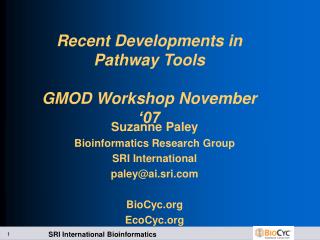
Recent Pathway Tools Performance Enhancements(Versions 13.0 to 14.5) Mario Latendresse October 2010 Bioinformatics Research Group SRI International latendre@ai.sri.com
Web Server Improvements (version 13.0 through 14.5) • Lossless Compression (version 13.0) • Compression of ‘.shtml’, ‘.html’, ‘.js’ files • “Minification” of JavaScript files (version 13.0) • JavaScript files (‘.js’) are statically minified • Keep-Alive (version 14.0) • An HTTP 1.1 mechanism to keep connected to the client to receive more than one HTTP requests. • File caching via the ‘expire’ HTTP parameter (version 14.5) • Web designers can specify their own expire duration (e.g., 2 days, 1 week, 3 months) when starting a Web server (parameter WWW-Browser-Static-Page-Expiry-Seconds in init-ptools.dat file) • Typically, Web requests are twice as fast when using all these improvements
BioVelo Speed Improvements in Pathway Tools (version 14.5) • BioVelo is used in most searching commands on the Web • The searching interfaces for genes/proteins/RNAs, compounds, reactions, pathways (under the Search menu in the top menu bar) • The Advanced Searches (SAQP, FFAQP) • Not the quick search • Much faster in searching and generating large outputs • This improvement was achieved by removing a basic constraint in Ocelot when manipulating multiple databases • Version 14.5 is often 2 to 10 times faster compared to version 14.0 (speedup depends on the size of the generated output)
Cellular Overview (14.5) • Much faster when visiting the different zoom levels (it takes about 4 seconds compared to 15 to 30 seconds in version 14.0) • Pre-generating the Cellular Overviews is key for good speedup (very soon an automatic way to do this for users) • Parsing the expression data is much faster (2 to 10 times faster) • More improvements are expected with new JavaScript engines for most popular browsers • Latest Chrome and Safari browsers are best now; Firefox is trailing behind; IE version 9 will be much better for JavaScript speed
Comparative Analysis Improvements • Improvements for the Desktop as well as the Web versions • For the desktop version using the genome comparative tool, we measured a speedup of about 4 (based on a comparison between ecocyc trpA and 48 other databases) • Speed up came from improving the speed when switch between organisms
Pathologic Speed Improvements • A new option “-fast” when starting Pathway Tools. • The creation of the PGDB is much faster due to several low-level Ocelot improvements • Quite noticeable on large genome or doing meta-genomics • It is about 5 times faster for large input files to Pathologic
Pathologic Predictive Improvements • Taxonomic range can be used to better predict pathways • Some name matcher improvements (the full set of possible suffixes and prefixes is applied) • More key reactions specified in MetaCyc