5.4 The Multiplication Principle
This section explores the Multiplication Principle and its application using tree diagrams to visualize possible outcomes. A practical example involves a rat navigating a maze with multiple routes, demonstrating how to count paths using the principle. The generalized form extends the concept to multiple operations, exemplified by selecting officers from a board of directors. By breaking down choices and calculating routes, we see how the total number of ways to complete tasks can be determined through multiplication. This fundamental concept in combinatorics is key to understanding probability and decision-making processes.


5.4 The Multiplication Principle
E N D
Presentation Transcript
5.4 The Multiplication Principle • Tree Diagram • Multiplication Principle • Generalized Multiplication Principle
Tree Diagram A tree diagram is a graph showing possibilities for an event having choices along the way. Suppose a rat in a maze starts at point A. There are five possible routes to get from point A to point B and 3 possible routes to get from point B to the final destination, point C. Represent the possible choices using a tree diagram.
Tree Diagram (2) Possible paths: 1a, 1b, 1c 2a, 2b, 2c 3a, 3b, 3c 4a, 4b, 4c 5a, 5b, 5c Total possible paths = 15
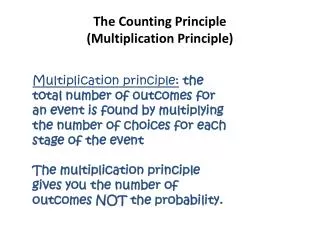
Multiplication Principle Multiplication Principle Suppose that a task is composed of two consecutive operations. If operation 1 can be performed in m ways and, for each of these, operation 2 can be performed in n ways, then the complete task can be performed in mn ways.
Example Multiplication Principle • Use the multiplication principle to determine the number of different paths a rat can take going from point A to point C if there are five possible routes to get from point A to point B and 3 possible routes to get from point B to point C. • There are 5 possible routes for task 1 and 3 possible routes for task 2 so there are 53 = 15 possible routes. This agrees with the tree diagram drawn previously.
Generalized Multiplication Principle Generalized Multiplication Principle Suppose that a task is composed of t operations performed consecutively. Suppose operation 1 can be performed in m1 ways; for each of these, operation 2 can be performed in m2 ways; for each of these, operation 3 can be performed in m3 ways; and so forth. Then the complete task can be performed in m1m2 m3…mt ways.
Example Generalized Principle • A corporation has a board of directors consisting of 10 members. The board must select from among its members a chairperson, vice chairperson, and secretary. In how many ways can this be done?
Example Generalized Principle (2) • The operations are: • 1. Select chairperson - there are 10 ways (people) to do this. • 2. Select a vice chairperson - there are 9 ways (9 people left after chairperson is chosen) to do this. • 3. Select a secretary - there are 8 ways to do this. • Total number of ways to complete task is 1098 = 720 ways.
Summary Section 5.4 • The multiplication principle states that the number of ways a sequence of several independent operations can be performed is the product of the number of ways each individual operation can be performed.