Princeton Univ MRSEC 0819860 IRG D Microresonators
Researchers at the Princeton Center for Complex Materials (PCCM) have achieved a groundbreaking 100-fold enhancement in the sensitivity of electron paramagnetic resonance (EPR) measurements. By integrating long-coherence donor electrons from isotopically enriched silicon with superconducting Nb microresonators, they can manipulate and measure electron spins with unprecedented precision. This innovative approach allows experiments with fewer electrons, particularly advantageous for quantum devices utilizing qubits. The results highlight the potential of these techniques in advancing the field of quantum materials and computational technology.

Princeton Univ MRSEC 0819860 IRG D Microresonators
E N D
Presentation Transcript
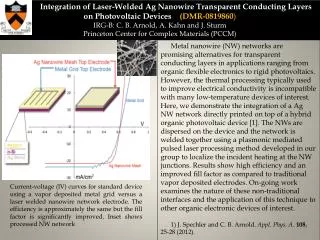
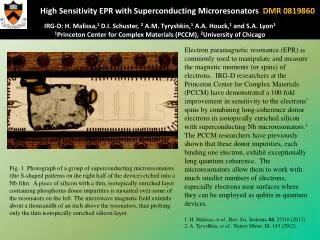
Electron paramagnetic resonance (EPR) is commonly used to manipulate and measure the magnetic moments (or spins) of electrons. IRG-D researchers at the Princeton Center for Complex Materials (PCCM) have demonstrated a 100 fold improvement in sensitivity to the electrons’ spins by combining long-coherence donor electrons in isotopically enriched silicon with superconducting Nb microresonators.1 The PCCM researchers have previously shown that these donor impurities, each binding one electron, exhibit exceptionally long quantum coherence. The microresonators allow them to work with much smaller numbers of electrons, especially electrons near surfaces where they can be employed as qubits in quantum devices. 1. H. Malissa, et al., Rev. Sci. Instrum. 84, 25116 (2013) 2. A. Tyryshkin, et al., Nature Mater. 11, 143 (2012). High Sensitivity EPR with Superconducting MicroresonatorsDMR 0819860IRG-D: H. Malissa,1 D.I. Schuster, 2 A.M. Tyryshkin,1 A.A. Houck,1 and S.A. Lyon11Princeton Center for Complex Materials (PCCM), 2University of Chicago Fig. 1 Photograph of a group of superconducting microresonators (the S-shaped patterns on the right half of the device) etched into a Nb film. A piece of silicon with a thin, isotopically enriched layer containing phosphorus donor impurities is mounted over some of the resonators on the left. The microwave magnetic field extends about a thousandth of an inch above the resonators, thus probing only the thin isotopically enriched silicon layer