Factoring Polynomials: Techniques and Guided Practice
160 likes | 284 Vues
This comprehensive guide covers the methods for factoring various polynomials, including finding common monomial factors, applying the difference of squares, and factoring perfect square trinomials. Each example walks through the steps necessary to factor completely, including guided practice problems to reinforce learning. The material is designed for students to master polynomial factoring techniques, ensuring a solid understanding of algebraic concepts. This resource includes examples, practice problems, and clear explanations for effective learning.


Factoring Polynomials: Techniques and Guided Practice
E N D
Presentation Transcript
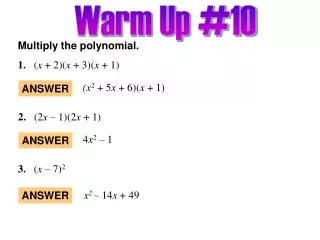
Warm Up #10 Multiply the polynomial. 1. (x + 2)(x + 3)(x + 1) (x2 + 5x + 6)(x + 1) ANSWER 2. (2x– 1)(2x + 1) 4x2– 1 ANSWER 3. (x – 7)2 x2 – 14x + 49 ANSWER
EXAMPLE 1 Find a common monomial factor Factor the polynomial completely. a. x3 + 2x2 – 15x = x(x2 + 2x – 15) Factor common monomial. = x(x + 5)(x – 3) Factor trinomial. = 2y3(y2 – 9) b. 2y5 – 18y3 Factor common monomial. = 2y3(y + 3)(y – 3) Difference of two squares = 4z2(z2 – 4z + 4) c. 4z4 – 16z3 + 16z2 Factor common monomial. = 4z2(z – 2)2 Perfect square trinomial
Apply the rule for sum of cubes: Write each monomial as a cube and apply either of the rules. Rewrite as cubes
Apply the rule for difference of cubes: Rewrite as cubes
for Examples 1 and 2 GUIDED PRACTICE Factor the polynomial completely. 2. 3y5 – 75y3 1.x3 – 7x2 + 10x
for Examples 1 and 2 GUIDED PRACTICE Factor the polynomial completely. 3. 16b5 + 686b2 2b2(2b + 7)(4b2 –14b + 49)
for Examples 1 and 2 GUIDED PRACTICE Factor the polynomial completely. 4. w3 – 27 (w – 3)(w2 + 3w + 9)
Factor by Grouping EXAMPLE 3 Factor the polynomial x3 – 3x2 – 16x + 48 completely. = x2(x – 3) –16(x – 3) x3– 3x2– 16x + 48 Factor by grouping. = (x2– 16)(x – 3) Distributive property = (x+ 4)(x – 4)(x – 3) Difference of two squares
Factor polynomials in quadratic form EXAMPLE 4 Factor completely:(a) 16x4 – 81and(b) 2p8 + 10p5 + 12p2. a. 16x4 – 81 = (4x2)2 – 92 Write as difference of two squares. = (4x2 + 9)(4x2 – 9) Difference of two squares = (4x2 + 9)(2x + 3)(2x – 3) Difference of two squares Factor common monomial. b. 2p8 + 10p5 + 12p2 = 2p2(p6 + 5p3 + 6) Factor trinomial in quadratic form. =2p2(p3 + 3)(p3 + 2)
for Examples 3 and 4 GUIDED PRACTICE Factor the polynomial completely. 5. x3 + 7x2 – 9x – 63 ANSWER (x+ 3)(x – 3)(x + 7)
for Examples 3 and 4 GUIDED PRACTICE Factor the polynomial completely. 6. 16g4 – 625 (4g2 + 25)(2g + 5)(2g – 5) ANSWER
for Examples 3 and 4 GUIDED PRACTICE Factor the polynomial completely. 7. 4t6 – 20t4 + 24t2 4t2(t2 – 3)(t2 – 2 ) ANSWER